Blood, Sweat, and Sawdust

Going against the grain

How to Use the Kell Honing Guide and Quickly Produce Keen Edges

Realizing that the Kell honing guide was a bit tricky to use effectively, I thought it would be good to write a follow up to my recent review, found here: A Review: The Kell Honing Guide
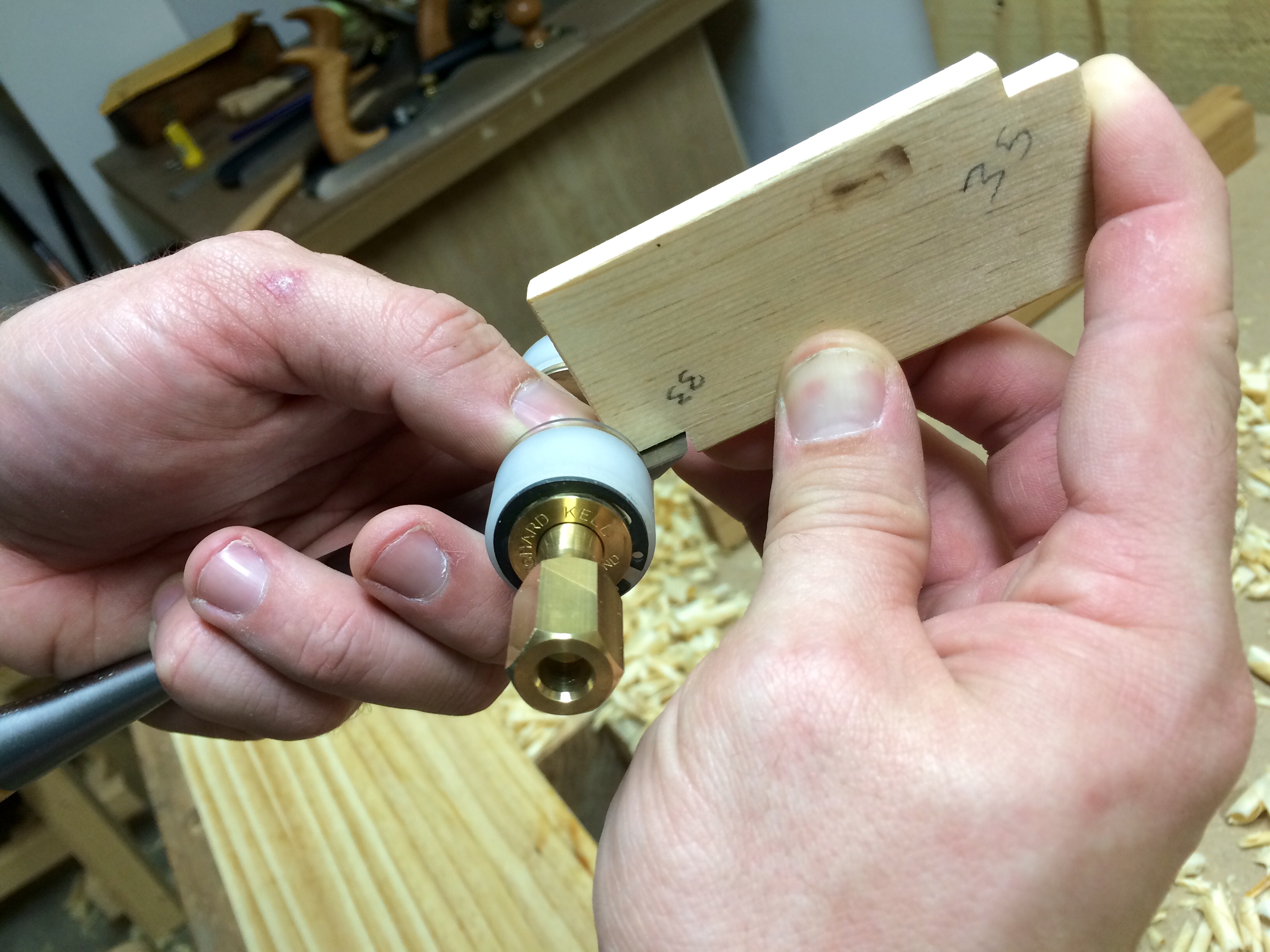
A registration jig makes setting angles a breeze for the Kell honing guide.

A registration jig makes setting angles a breeze for the Kell honing guide.

The first thing to note is that making a registration jig will make this tool much easier to use. The instructions include a list of measurements to achieve a desired honing angle. The measurements are taken from the edge of the blade to the first registration bar. My registration jig is nothing more than a simple piece of scrap, slightly thinner than my narrowest chisel. This allows me to register the edge in one of two notches I cut, and slide the jig back until it touches the registration bar on the honing guide. Each notch represents a different honing angle.
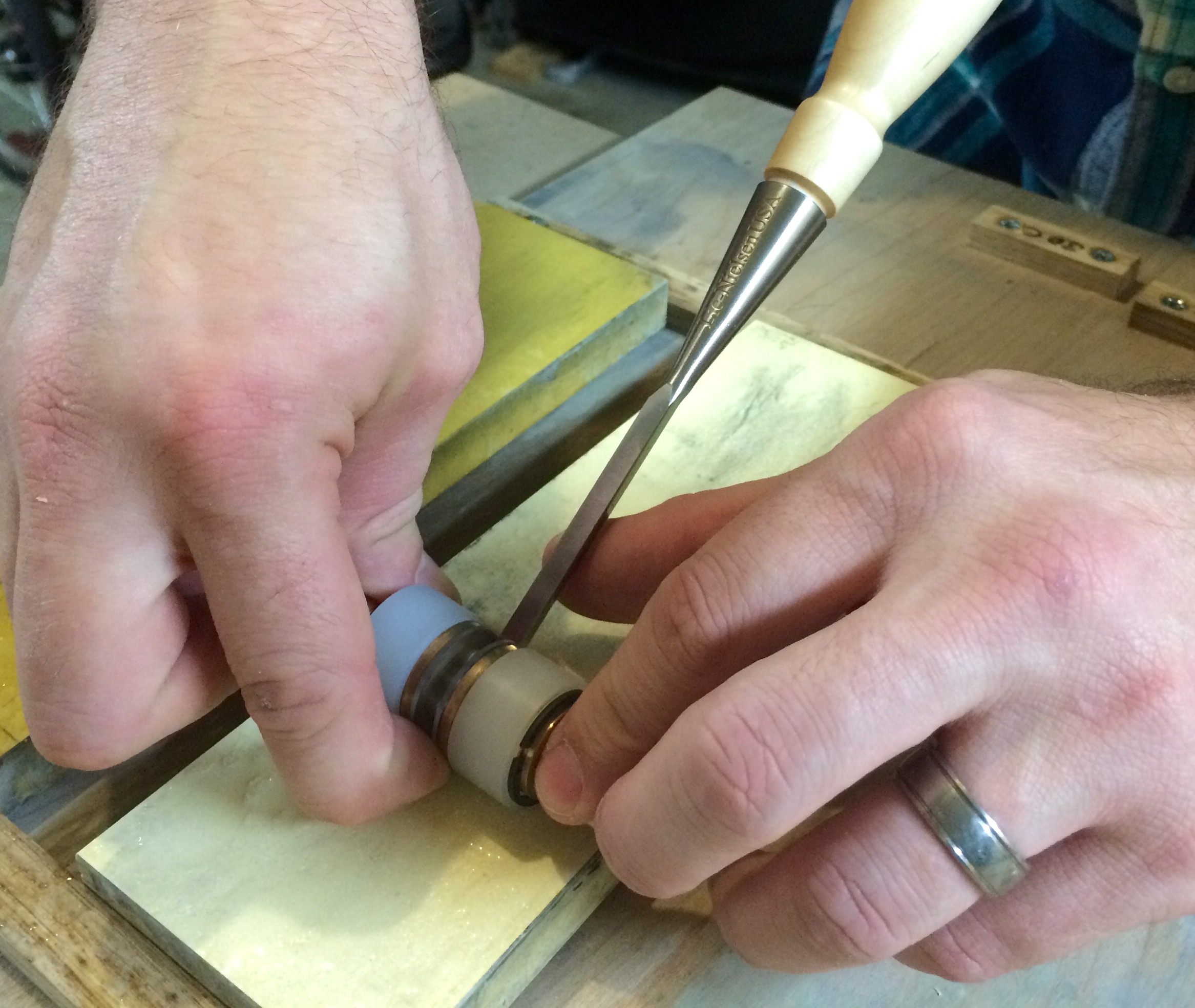
Holding the guide for small chisels

Holding the guide for small chisels

Red arrows indicate where to hold guide.

Red arrows indicate where to hold guide.

To hone my narrowest chisels, I am able to hold on to the end of the registration bars to the left, and the adjustment knob on the right. I apply pressure to the edge using on finger and draw the entire guide back.
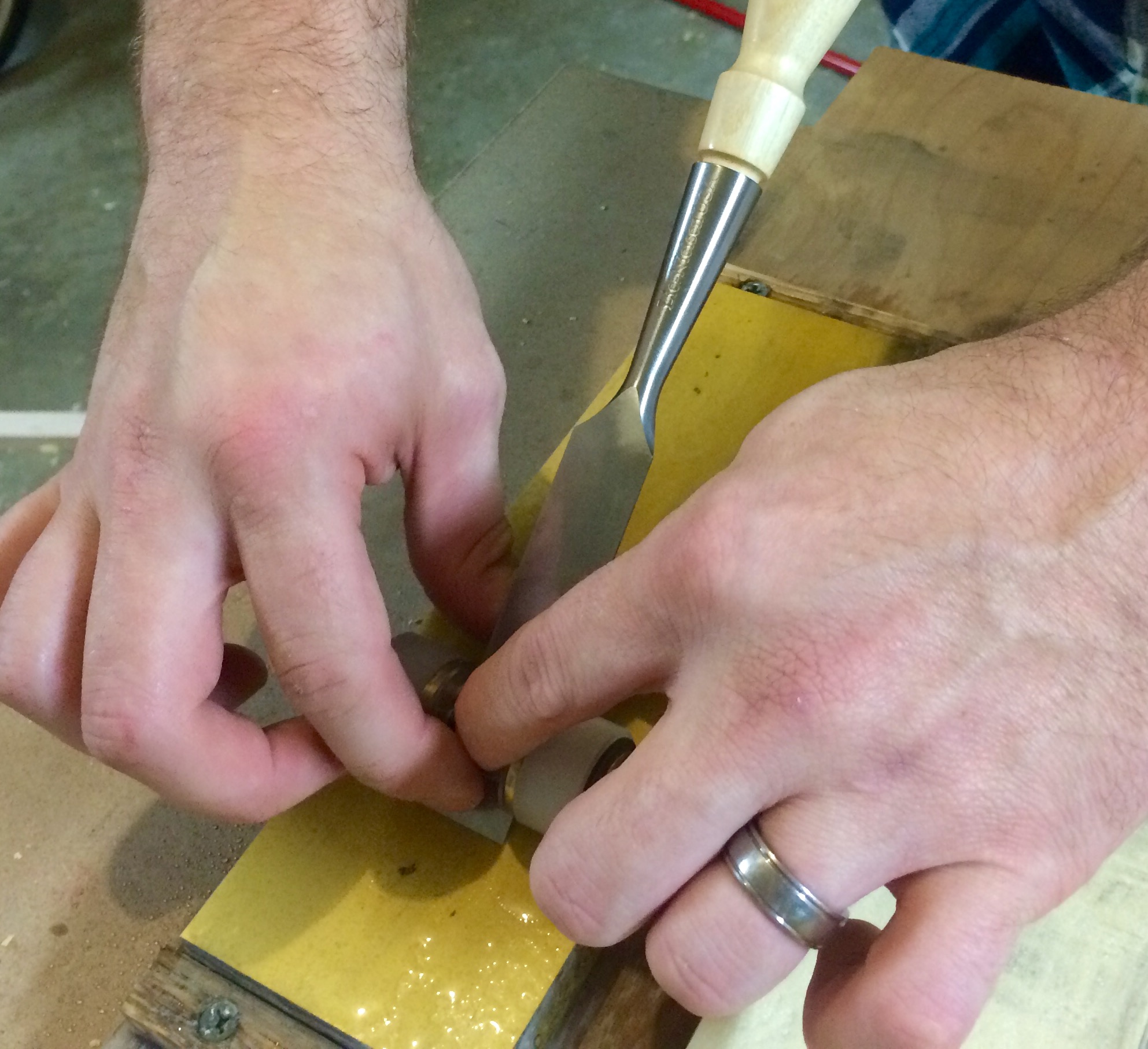
Holding the guide for wide chisels
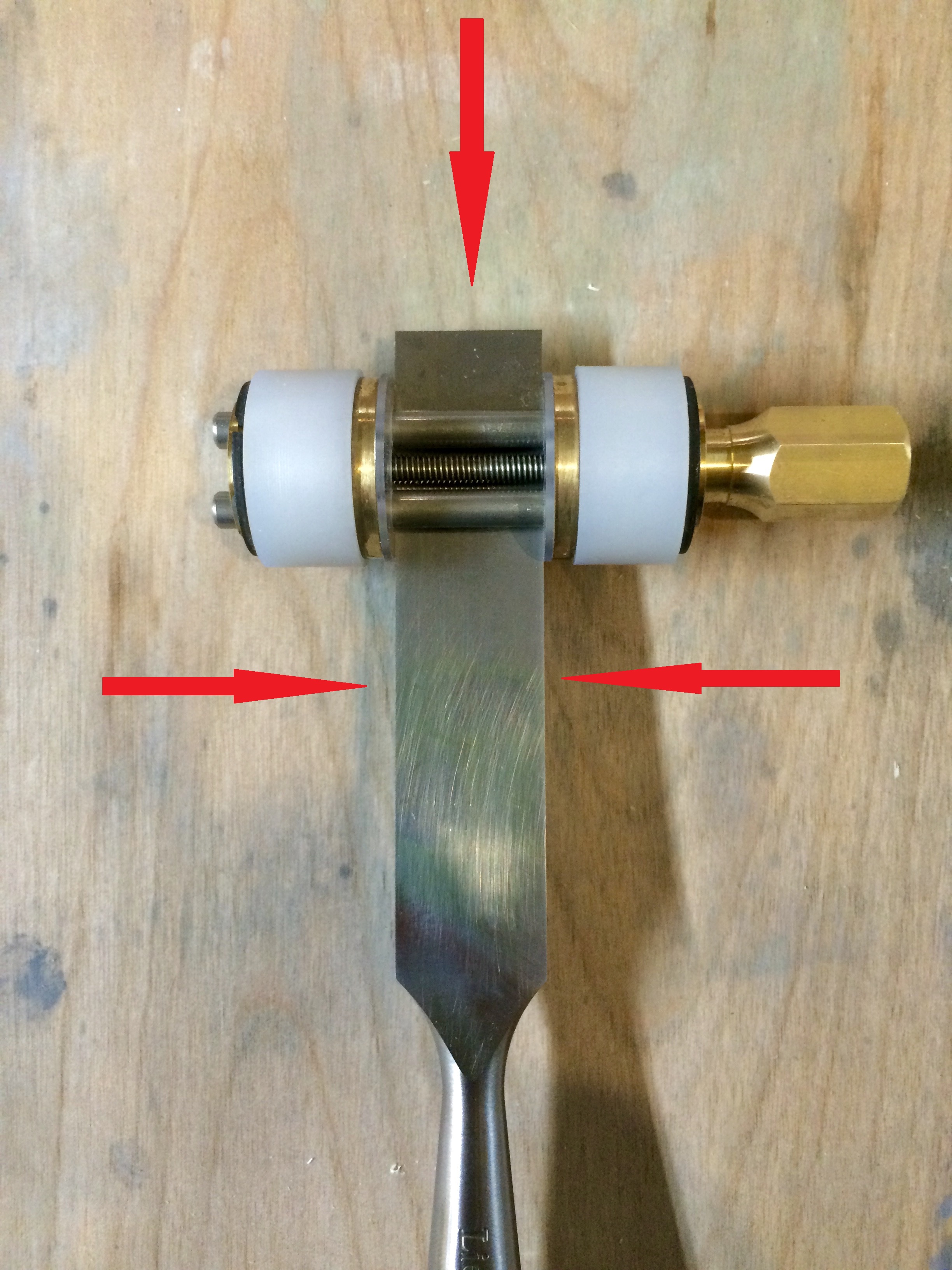
Holding the guide for wide chisels

Arrows indicate where to hold the guide

Arrows indicate where to hold the guide

On my widest chisels, the registration bars aren’t available to grasp. Instead, I apply pressure to the edge with my index fingers, and pressure to the back of the blade (just above and behind the honing guide) with my thumbs. This locks the whole assembly in place, despite not really touching the guide itself. Chisels in between, are even easier to deal with.

I didn’t find it too difficult to get used to these modified techniques and would still highly recommend the Kell honing guide for chisels.  It may look odd to hold in the pictures, but it is actually quick, easy, and comfortable.  In both cases, I simply draw the guide back towards myself.  I lift sightly on the return to prevent gouging.  In most cases it only takes 10 or so swipes to produce a burr.  This, in part, is owed to the fact that the Kell guide makes it easy to produce consistent swipes across the stone and holds the chisel dead square.
Roubo Build: Rough Milling the Beams for the Bench Top

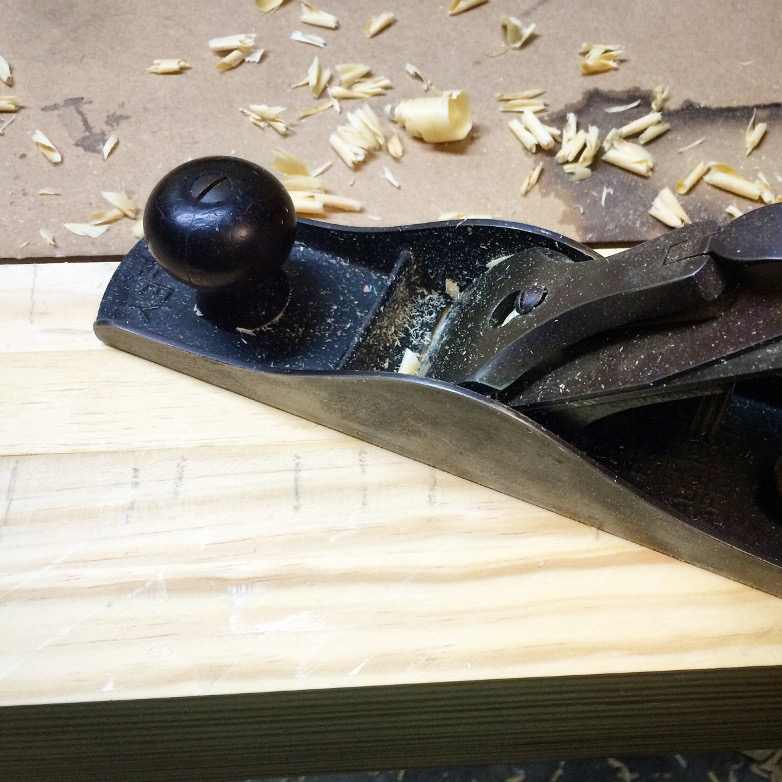
Rough milling always starts with my trusty Jack plane

Rough milling always starts with my trusty Jack plane

Rough milling large beams by hand, can be very intimidating. I had a few boards slip during glue-up and was afraid it would take forever to correct. Fortunately, a sharp jack plane with a cambered iron made quick work of the rough milling for the Roubo bench top.

Glue up slippage

Glue up slippage

I started by planing with the grain until I leveled out any misaligned boards.  I would usually start planing across the grain, but in this case I could remove the same amount of material in one long pass with the grain as I could several short strokes across the grain.  In the picture above, you can how some of the boards slipped during glue up.  I should have taken more effort to keep the boards properly aligned during the glue up.

Mark out your board

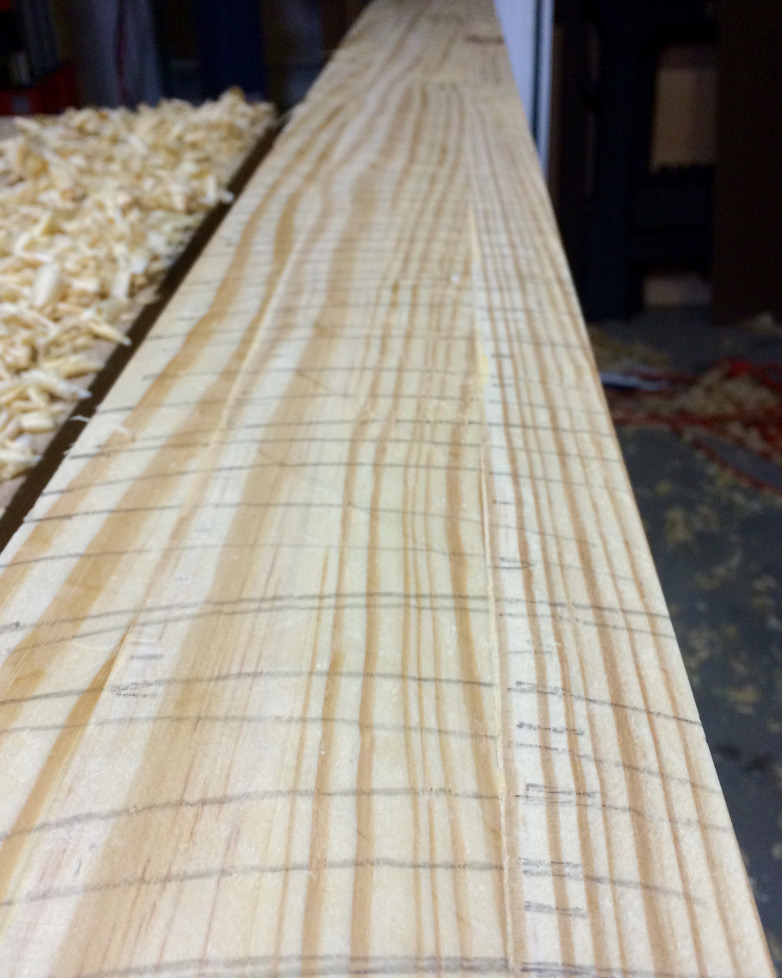
Mark out your board

Once I had leveled out the high boards, I marked out the entire beam with pencil.  This will allow me to track my progress.  Be sure to mark from edge to edge.  Now it was time to get to work.  I hope you ate your Wheaties!

Planing cross grain is particularly good at removing cupping

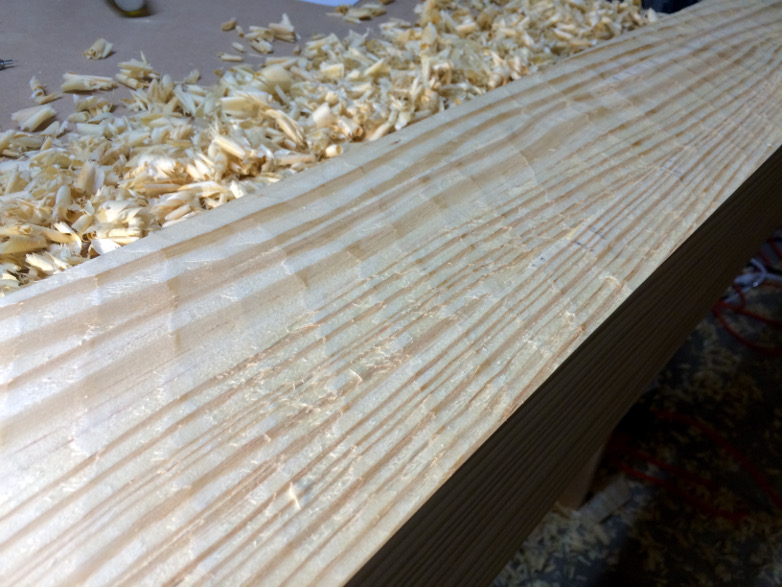
Planing cross grain is particularly good at removing cupping

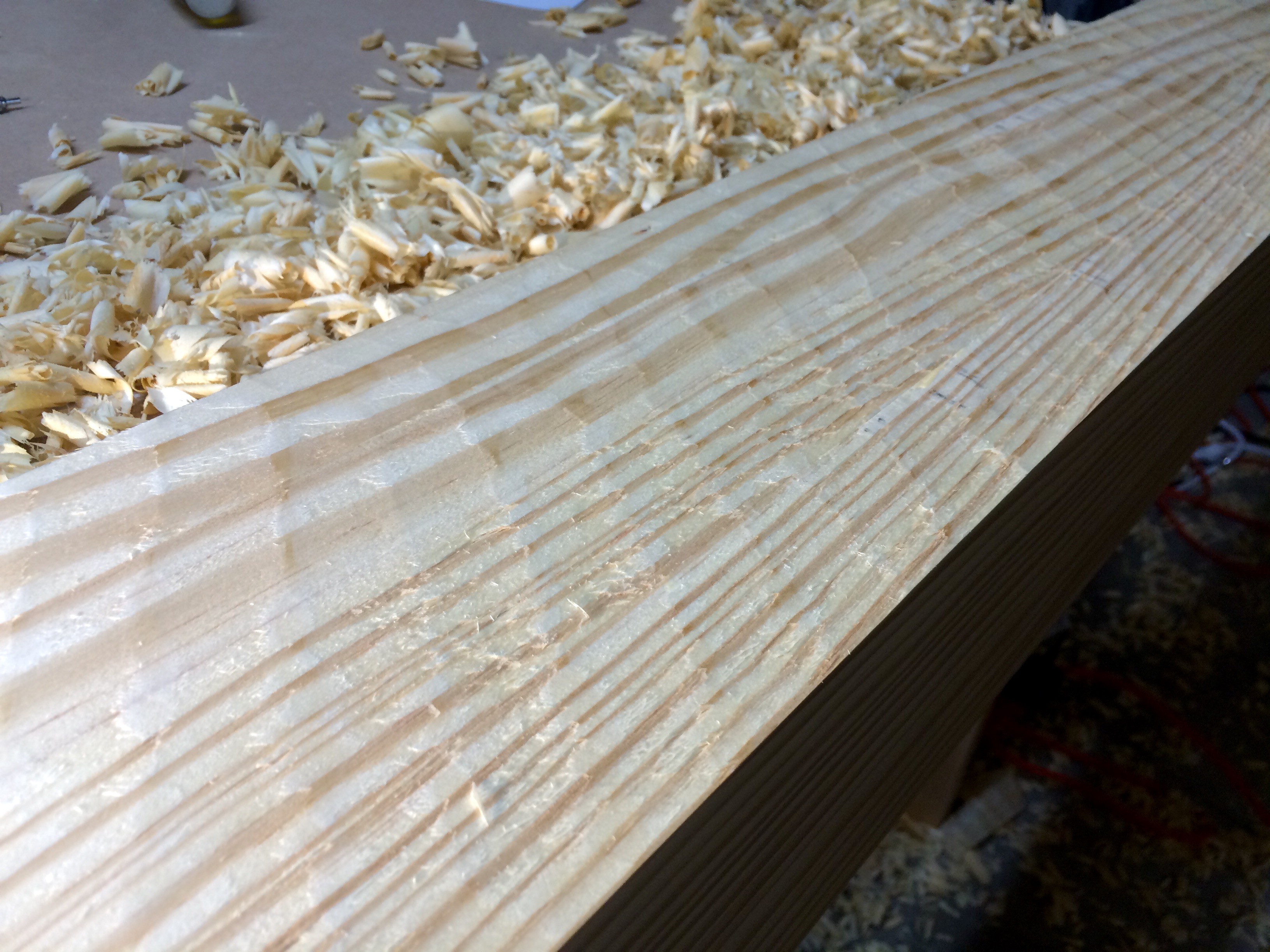
Next, I start flattening the beam by planing across the grain.  This is particularly good at removing cupping.  These beams are just over 5 inches wide, so it would be easy to round over the edges planing 90 degrees to the grain.  Instead, I planed down the length at 45 degrees one way, and back down the other way.  My iron is heavily cambered and leaves a visibly scalloped surface.  That’s okay.  All I am shooting for is a face that’s flat and straight enough to run through the planer.  It does not need to be super smooth.  I continue until all of my pencil marks have been removed.

Ultimately, I just want to make sure that the surface is straight and free of any bumps.  You can check for any bumps along the length of your plank by using a straightedge or the blade of a square.

The winding sticks are showing a fair amount of twist

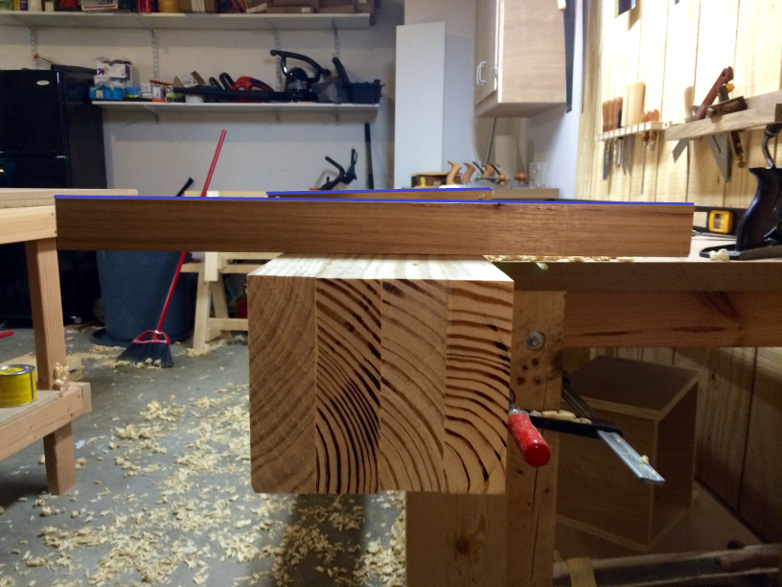
The winding sticks are showing a fair amount of twist

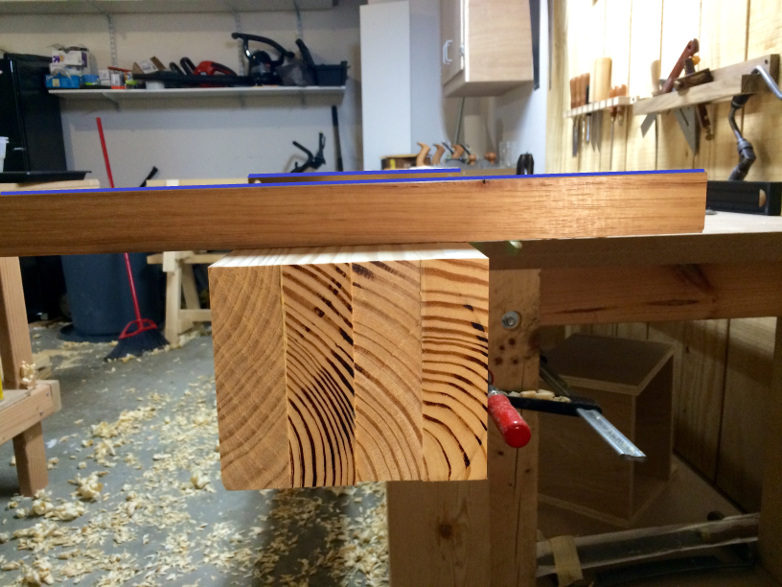
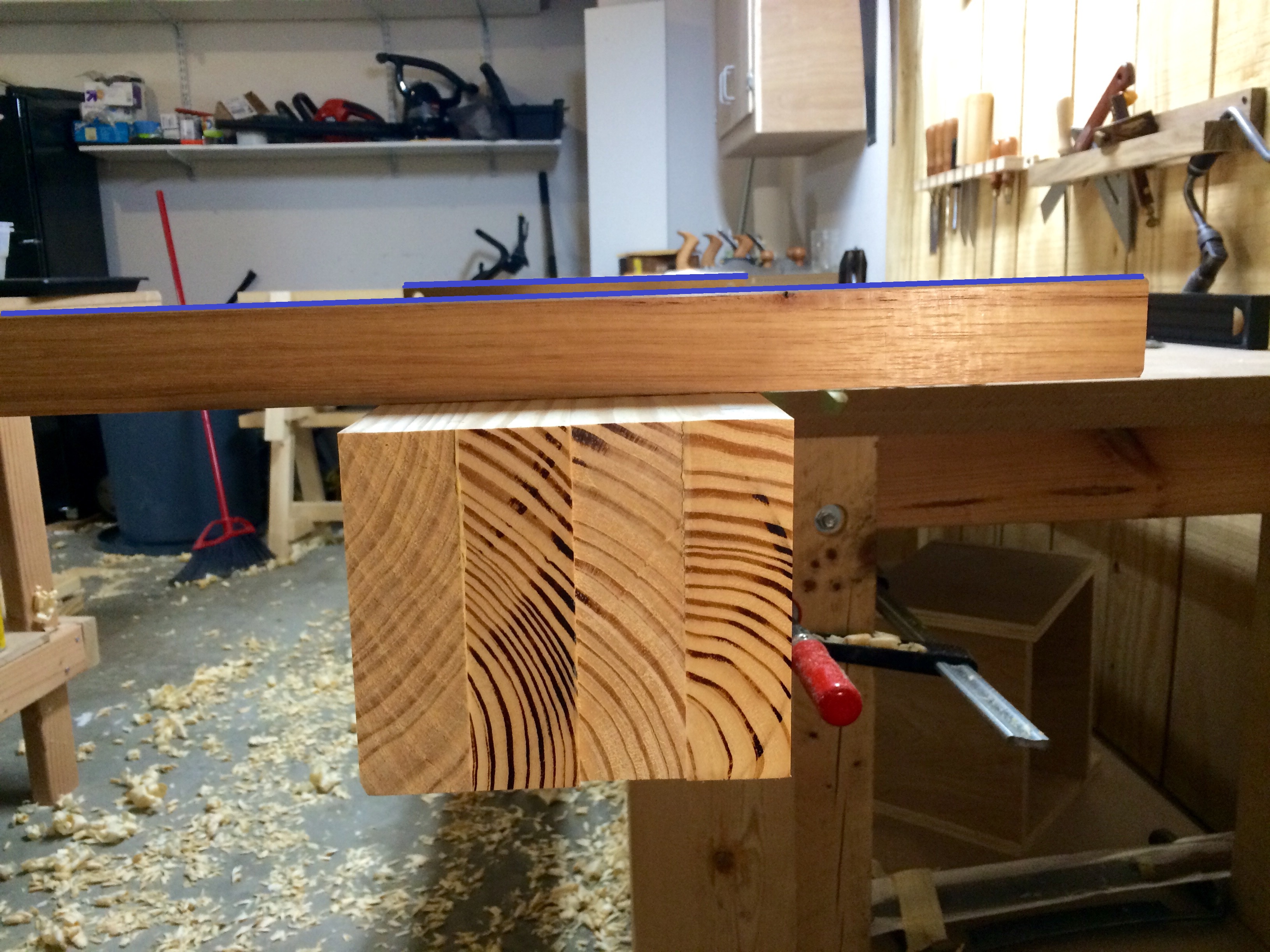
The next task is to check the beam for twist using a pair of winding sticks.  The winding sticks will exaggerate the twist and tell you where your high spots are.  I like to keep one stick stationary at one end of the board, and run the other down the length, checking in 3 or 4 places.  In this case, I noted that the rear stick read high on the right for the entire length of the board.  Instead of removing material from the entire length, it was easier to remove a small amount of material from the front left, to match the rest of the board.

The twist has been removed.

The twist has been removed.

Checking for Bow Along the Length

Checking for Bow Along the Length

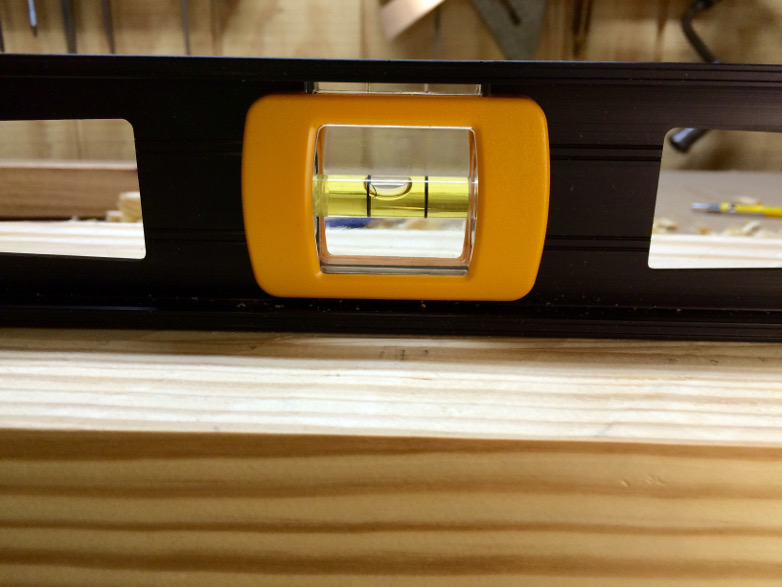
Once you have your plank flat and free of twist, you need to ensure that it’s reasonably straight.  I do this, by using the longest straight edge I have.  In this case, it was a 4 foot level I know to by reasonably straight.  Be sure to check in several places.  I was lucky.  This board was nearly dead straight.  However, if you have a bump or concavity, it’s just a matter of marking and removing the high spots.

I didn’t feel the need to break out the No. 7 for this task.  Running the beams through the planer will produce an parallel surface that is straight, free-of-twist, and smooth.  It’s just a matter of flipping the board over and getting the other side smooth.  The No. 7 will come in handy when flattening the bench top after the final glue up.

Please, let me know if you have any questions.  I will cover the rest of the milling process and the final glue up of the top in a future article.  Don’t miss it.

You can find links to my other Roubo posts here:  Project Index

Roubo Build: Milling the Beams for the Top

Trusty Jack

My trusty Type 11 Stanley No. 5, made quick work of milling these beams by hand.

Milling large beams by hand, can be very intimidating. I had a few boards slip during glue-up and was afraid it would take forever to correct. Fortunately, a sharp jack plane with a cambered iron made quick work of the rough milling for the Roubo bench top.

Glueup Slippage

These boards slipped during glue-up

I started by planing with the grain until I leveled out any misaligned boards.  I would usually start planing across the grain, but in this case I could remove the same amount of material in one long pass with the grain as I could several short strokes across the grain.  In the picture above, you can how some of the boards slipped during glue up.  I should have taken more effort to keep the boards properly aligned during the glue up.

Marking out the beams

Marking out your work, allows you to track your progress

Once I had leveled out the high boards, I marked out the entire beam with pencil.  This will allow me to track my progress.  Be sure to mark from edge to edge.  Now it was time to get to work.  I hope you ate your Wheaties!

Planing Cross Grain

Planing cross grain will flatten the board. It’s particularly good at remove cupping.

Next, I start flattening the beam by planing across the grain.  This is particularly good at removing cupping.  These beams are just over 5 inches wide, so it would be easy to round over the edges planing 90 degrees to the grain.  Instead, I planed down the length at 45 degrees one way, and back down the other way.  My iron is heavily cambered and leaves a visibly scalloped surface.  That’s okay.  All I am shooting for is a face that’s flat and straight enough to run through the planer.  It does not need to be super smooth.  I continue until all of my pencil marks have been removed.

Ultimately, I just want to make sure that the surface is straight and free of any bumps.  You can check for any bumps along the length of your plank by using a straightedge or the blade of a square.

The winding sticks are showing a fair amount of twist

The winding sticks are showing a fair amount of twist

The next task is to check the beam for twist using a pair of winding sticks.  The winding sticks will exaggerate the twist and tell you where your high spots are.  I like to keep one stick stationary at one end of the board, and run the other down the length, checking in 3 or 4 places.  In this case, I noted that the rear stick read high on the right for the entire length of the board.  Instead of removing material from the entire length, it was easier to remove a small amount of material from the front left, to match the rest of the board.

No twist

No twist

Checking for bow

Checking for bow

Once you have your plank flat and free of twist, you need to ensure that it’s reasonably straight.  I do this, by using the longest straight edge I have.  In this case, it was a 4 foot level I know to by reasonably straight.  Be sure to check in several places.  I was lucky.  This board was nearly dead straight.  However, if you have a bump or concavity, it’s just a matter of marking and removing the high spots.

I didn’t feel the need to break out the No. 7 for this task.  Running the beams through the planer will produce an parallel surface that is straight, free-of-twist, and smooth.  It’s just a matter of flipping the board over and getting the other side smooth.  The No. 7 will come in handy when flattening the bench top after the final glue up.

Please, let me know if you have any questions.  I will cover the rest of the milling process and the final glue up of the top in a future article.  Don’t miss it.

You can find links to my other Roubo posts here:  Project Index

A Review: The Kell Honing Guide

The Kell Honing Guide

The Kell Honing Guide

I’ve probably been down every sharpening rabbit hole that exists. I’m always searching for the ultimate in terms of edge maintenance. It’s not all about the keenest edge possible. For me, it’s just as important to have a system that’s quick and easy to use. I’ve had a great system for my plane irons for a while. However, I’ve never been satisfied with the various systems I’ve tried for chisel maintenance.

For a while, I used the Veritas Mk II honing guide. It worked great, but that was fussy and took too long to setup. I turned to a cheap Eclipse knock-off guide to simplify setup. I still use it for my plane irons, but it tends to skew my chisels and doesn’t work for my narrowest blades. Next, I braved the world of free-hand sharpening. I had consistency issues, and felt that I had to regrind more often. This is due to the fact that you’re removing material from both the edge and the heal of the bevel instead of just the edge. It was about this time that someone recommended the Kell honing guide.

Stop block for setup

A simple stop block from a piece of scrap makes setup a piece of cake.

I was hesitant at first , due to the initial cost. On a whim, I made the short trip down to Highland Hardware and picked one up. I quickly fell in love. Using a simple stop block, it’s every bit as simple as the Eclipse style guides. It’s exceptionally well made, and always holds my blades square. It even works with my 1/8th inch chisel. My only complaint is that the design limits you to using the center part of your sharpening stones. As a result, beware of uneven stone wear and keep on top of your stone maintenance. Did I mention that this thing is beautiful?

Kell guide with 1/8th inch chisel

It even works great on very narrow chisels

I have no affiliation with Mr. Kell or Highland Hardware, but the jig can be found here: http://www.highlandwoodworking.com/kellhoningjig1incapacity.aspx

Bench Top Lamination Follow Up

Beams for the Roubo Bench Top

Beams for the Roubo Bench Top

I finished the last section of my bench top lamination and  learned some valuable lessons along the way. Overall, things went well, but there are a few things I would do differently in the future. The biggest challenge was the sheer number of boards for the top and their cumbersome length.

Here are the tips I found most useful:

  • Rehearse your glue up before applying any glue – do this for each section
  • Skip planing is more than fine for this type of glue-up, but beware of hard-to-see snipe
  • Before milling, cleanup your shop. There’s nothing worse than tripping over things will ripping 8 ft long boards in a small shop.
  • A small paint roller speeds up glue application
  • Use glue with a long open time. Titebond Extend will give you plenty of time to get your boards coated and aligned
  • Take your time. I ended up with a couple of sections that have a board slightly misaligned. Even an error of 1/16th will add a lot of work to the final milling
  • Don’t skimp on edge jointing, before ripping your boards to width. This will help ease alignment during your glue-up.
  • Don’t skimp on the glue.
  • While we’re at it, don’t skimp on the clamps.  Use as many as you have.
  • If using a resinous wood, wipe the surfaces down with a fast drying solvent before applying glue.  This will allow the glue to penetrate deeper.
  • Allow the squeeze out to become leathery and scrape as much off as possible before it fully hardens

If anyone else out there has similar experience, what tips did you find useful?

You can find links to my other Roubo posts here:  Project Index

Benchtop Lamination Follow Up

Bench Top Sections Glued Up

Bench Top Sections Glued Up

I finished the last section of my bench top and I learned some valuable lessons along the way. Overall, things went well, but there are a few things I would do differently in the future. The biggest challenge was the sheer number of boards for the top and their cumbersome length.

Here are the tips I found most useful:

  • Rehearse your glue up before applying any glue – do this for each section
  • Skip planing is more than fine for this type of glue-up, but beware of hard-to-see snipe
  • Before milling, cleanup your shop. There’s nothing worse than tripping over things will ripping 8 ft long boards in a small shop.
  • A small paint roller speeds up glue application
  • Use glue with a long open time. Titebond Extend will give you plenty of time to get your boards coated and aligned
  • Take your time. I ended up with a couple of sections that have a board slightly misaligned. Even an error of 1/16th will add a lot of work to the final milling
  • Don’t skimp on edge jointing, before ripping your boards to width. This will help ease alignment during your glue-up.
  • Don’t skimp on the glue.
  • While we’re at it, don’t skimp on the clamps.  Use as many as you have.
  • If using a resinous wood, wipe the surfaces down with a fast drying solvent before applying glue.  This will allow the glue to penetrate deeper.
  • Allow the squeeze out to become leathery and scrape as much off as possible before it fully hardens

If anyone else out there has similar experience, what tips did you find useful?

You can find links to my other Roubo posts here:  Project Index

The Tale of the Tail Jig

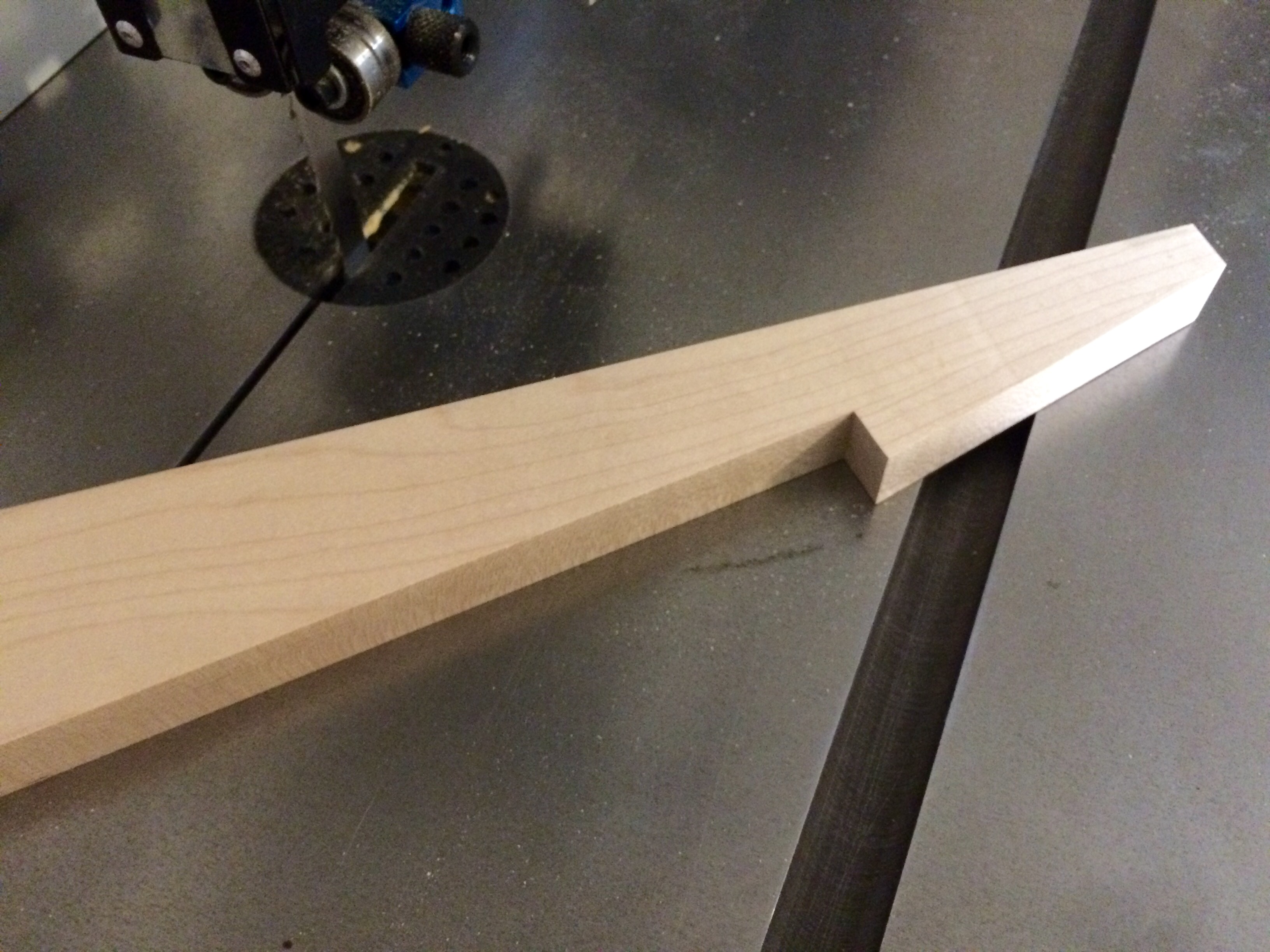
Jig1My handsaw skills might be lacking, but I do enjoy cutting most of my joinery by hand. However, when I have a bunch of identical joints to cut, I turn to jigs.

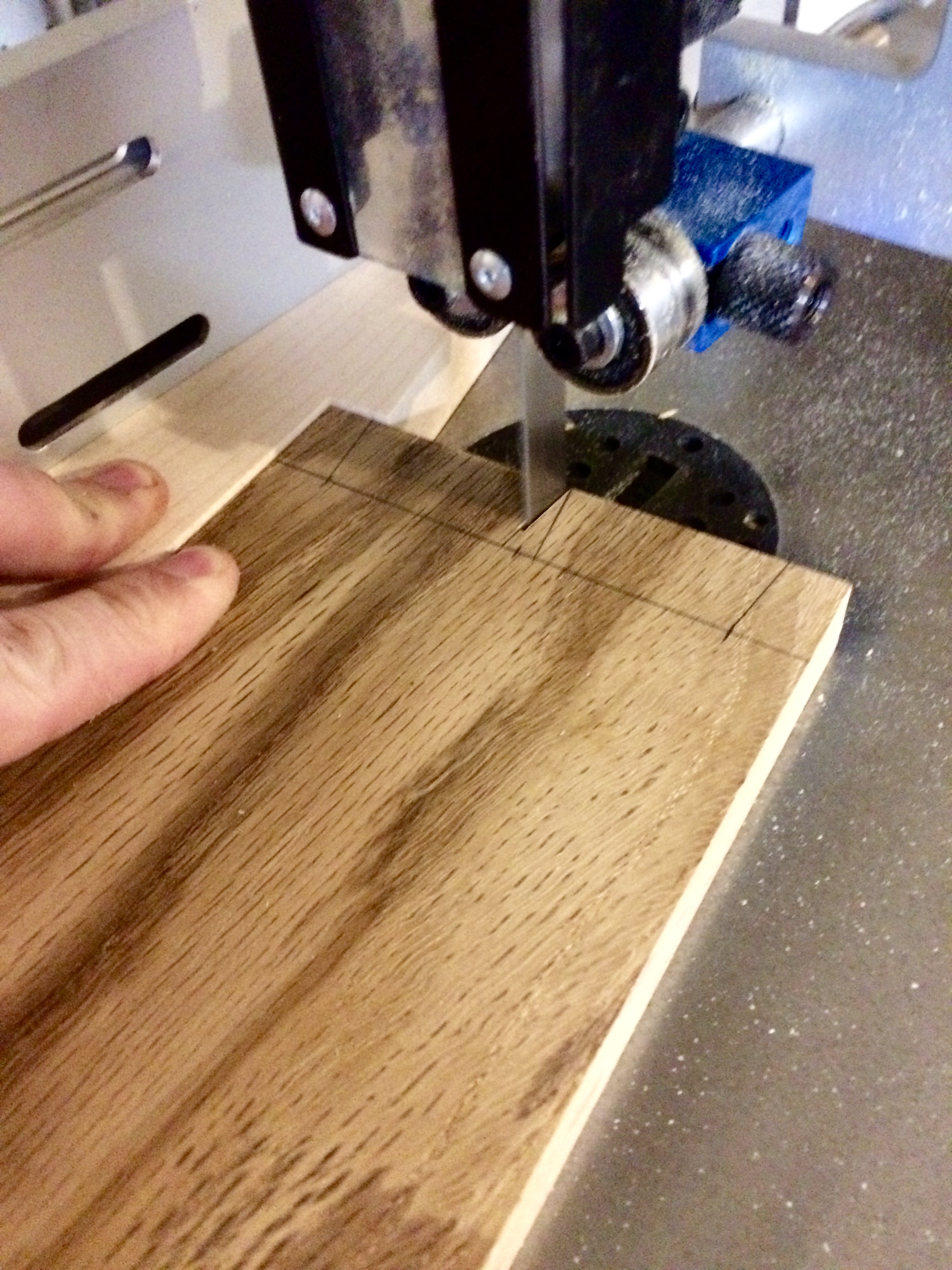
I recently discovered this little jig for cutting tails on the bandsaw. It’s little more than a wedge with a stop at one end. To make it, you simply cut a wedge to your desired angle, cut off the tip, flip it around and glue it back on. To use it, you register your board on the stop and slide the opposite edge along the fence of your bandsaw.

Jig2

The beauty of this jig is that you can make several cuts without adjusting your fence. Start by marking out your tails on  one end of your board.  Using the jig, adjust the fence of your bandsaw to line up with your first cut. Assuming your tails are symmetrical, you should be able to take two cuts from each end of your board. You end up only needing to adjust the fence once for each tail you’re cutting.  Dead square tails are just icing on the cake.

What jigs do you use to supplement your handtool work?

Sketchup to the Rescue

Roubo

While reviewing the instructions for my Bench Crafted leg vise, I realized that the location of the tenon for my front stretcher was going to interfere with the mortise of the criss-cross. Bench Crafted provides details on how to work around this if you’re using their nuts and bolts. However, I wanted to stay as traditional as possible and drawbore the stretchers. I quickly turned to SketchUp to see what could be done.

After tinkering around a bit, I discovered that the solution wouldn’t be difficult at all. I need to move the location of the mortise for the stretcher back a bit. I want to have at least half an inch between the two mortises. The original location was 1 1/4 inch behind the front edge of the leg. Moving the mortise back to 2 inches gives me room to spare. I will also need to thicken the front stretcher in order for it to remain flush with the front of the legs.

Leg Joints

Criss-cross Mortise on the left, and stretcher on the right

Crisis averted.

The only thing I have left to do is layout the dog / holdfast holes, and design the vise chop.

If you’re not yet using SketchUp for your projects, I would highly recommend you look into it. The software is free and there’s a great instructional series on http://sketchupforwoodworkers.com/

You can find links to my other Roubo posts here:  Project Index

Bench Top Lamination without Lamentation

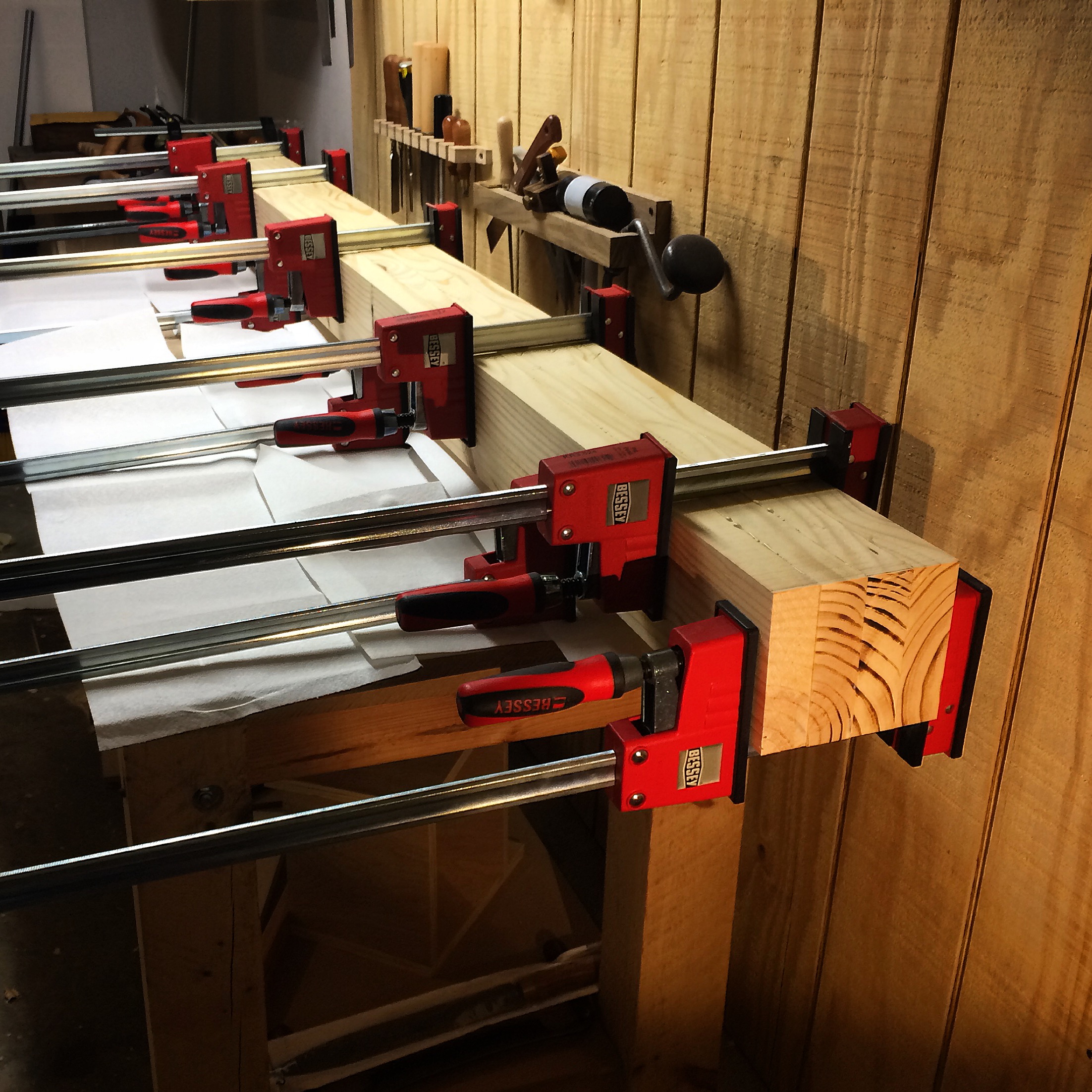
Bench Top Lamination in Clamps

Bench Top Lamination in Clamps

This was the first time I’ve ever attempted a large bench top lamination. To say that I was a bit nervous would be an understatement. What if I experienced delamination? What if I couldn’t get the boards aligned properly? What if I ended up with miscellaneous items accidentally glued to my laminated assembly?  In the end, my fears were put to rest, and careful planning resulted in a successful lamination.

With the individual boards ripped to width, I just need to finish milling them.  Most of the boards were quartersawn with little cupping or twist.  I didn’t see much benefit in jointing a face, so I just ran both sides through my lunch box planer.  I marked grain direction on the edge of each board, so that I could ensure the grain would run in the same direction for the entire assembly.  Next, I did a dry run to figure out the best location for each board.  I wanted the outside boards to bow inwards, so that I would end up with a spring joint.  I also wanted to make sure that I could close up any gaps by hand.

After a deliberate rehearsal, It was time to get started. I double checked to make sure that everything was in its right place. I made sure that my workbench and floor surfaces were protected. Then, I laid out several clamps, placed my boards on top, and made sure they were in the correct order. Next, I wiped down the surface of each board with acetone. This will remove any resin and help the glue penetrate better. Using a small 6″ paint roller, I carefully rolled on Titebond Extend wood glue on one face of each board. I carefully aligned the boards and started clamping down the outermost clamps. I proceeded to add clamps every 6″ or so, alternating top to bottom. I ended up using 12 clamps total. The only thing left, was to wait.

I decided to leave the assembly in clamps for approximately 24 hours. I was terrified that I would release the final clamp, only to have the assembly explode in a shower of splinters and sawdust. Fortunately for me, this was not the case. Everything held up very well. The glue lines are nice and tight on both sides.

There are only two things I will do differently for the next assembly. I will apply glue to both faces of every joint, and I will scrape the excess glue off before it fully hardens.

Stay tuned.

You can find links to my other Roubo posts here:  Project Index

Lamination without Lamentation

Laminated Assembly in Clamps

Laminated Assembly in Clamps

This was the first time I’ve ever attempted laminating boards for a bench top. To say that I was a bit nervous would be an understatement. What if I experienced delamination? What if I couldn’t get the boards aligned properly? What if I ended up with miscellaneous items accidentally glued to my laminated assembly?  In the end, my fears were put to rest, and careful planning resulted in a successful lamination.

With the individual boards ripped to width, I just need to finish milling them.  Most of the boards were quartersawn with little cupping or twist.  I didn’t see much benefit in jointing a face, so I just ran both sides through my lunch box planer.  I marked grain direction on the edge of each board, so that I could ensure the grain would run in the same direction for the entire assembly.  Next, I did a dry run to figure out the best location for each board.  I wanted the outside boards to bow inwards, so that I would end up with a spring joint.  I also wanted to make sure that I could close up any gaps by hand.

After a deliberate rehearsal, It was time to get started. I double checked to make sure that everything was in its right place. I made sure that my workbench and floor surfaces were protected. Then, I laid out several clamps, placed my boards on top, and made sure they were in the correct order. Next, I wiped down the surface of each board with acetone. This will remove any resin and help the glue penetrate better. Using a small 6″ paint roller, I carefully rolled on Titebond Extend wood glue on one face of each board. I carefully aligned the boards and started clamping down the outermost clamps. I proceeded to add clamps every 6″ or so, alternating top to bottom. I ended up using 12 clamps total. The only thing left, was to wait.

I decided to leave the assembly in clamps for approximately 24 hours. I was terrified that I would release the final clamp, only to have the assembly explode in a shower of splinters and sawdust. Fortunately for me, this was not the case. Everything held up very well. The glue lines are nice and tight on both sides.

There are only two things I will do differently for the next assembly. I will apply glue to both faces of every joint, and I will scrape the excess glue off before it fully hardens.

Stay tuned.

You can find links to my other Roubo posts here:  Project Index