Blood, Sweat, and Sawdust

Going against the grain

The Fundamentals of Furniture Design: Finding Inspiration

Design inspiration is all around you, awaiting discovery.  You just have to know where to look.  It often turns up where you least expect it.  You’ll find inspiration in nature.  You’ll find it in the designs of others.  Often, you’ll find inspiration in areas remotely related to furniture making.  Be careful not to design cheap copies.  A wise man once said, “originality is the art of carefully concealing your source”.  For example, borrow the proportions of a classic design and apply it to a modern one.  Take the moldings or ornamentation from your favorite piece of architecture and re-purpose it in your design.  Don’t leave any stone unturned.  Look everywhere for inspiration.

Nature never fails to provide design inspiration

Nature never fails to inspire

Nature

Inspiration is ripe in the natural world.  You can borrow forms from both the animal and plant kingdoms.  You can even take them from the microscopic world.

The spiral of a sea shell supplies inspiration for a table top.  The shape of a pine cone reveals itself in the shape of the finials on a bed post.  The natural world even influences the columns of the Corinthian classical order.  Don’t stop at the basic shapes on forms.  Nature also supplies ques for color, contrast, texture, and proportion.  Living things aren’t the only source of inspiration in the natural world.  Geology also supplies insight.

The Man-Made World

The men and women who came before us left design ques everywhere.  Once discovered, use them in your designs in new and creative ways..

If you like cars, recreate the curves of your favorite model in a table or chair.  Use the proportions of your favorite building in that chest of drawers you want to build.  Boats, airplanes, temples, city layouts, even kitchen appliances:  All great sources of inspiration for you next project.  It’s okay to take ques from the furniture others have made.  Just make sure that you keep it to an influence and avoid an outright copy.

Don’t forget to look past the shapes and forms you see.  Look for details and takes notes.

Finding Design Inspiration on the Web

There are countless sources of inspiration on the Internet.  A simple Google image search reveals page after page of material.  Pinterest is a great source of inspiration (if you haven’t already, sign up for a free account and follow some furniture makers).  There are countless design blogs to follow.  YouTube is also an excellent resource.

To summarize, inspiration is found in many places that the average designer fails to look.  Keep a notebook nearby and jot down anything that inspires you.

What is the most unusual source of inspiration you’ve seen used for a piece of furniture?

Fundamentals of Design: Series Index


That’s a bit of a Stretch…

With  all four legs fitted to the top, I’m rounding 3rd and heading for home.  That’s a bit of a stretch.  I still have many details to work out, a vise to install, chop and sliding dead-man to complete, and the stretchers.

Fitting the Roubo Workbench Stretchers

I milled up the stretchers much the same way I completed the legs.  I am using the Bench Crafted criss-cross and their classic leg vise hardware.  The criss-cross mortise location requires an atypical front stretcher.  I made the front stretcher extra thick, so that I can move the mortise further back and keep the front of the stretcher flush with the front of the leg.

Cabinet Makers Triangle

Cabinet Makers Triangle

Before doing anything else, label the bottom of your stretchers with a cabinet makers triangle.  I always keep mine pointed in the same direction.

Clamp your stretcher to your leg

Clamp your stretcher to your leg, using an offcut as a spacer.

To locate the tenon shoulder to stretchers, I stole a little trick from Chris Schwarz.  I cut several spacers the same length as the distance between the bottom of the bench top and the top of the stretchers.  I then clamped two of the spacers to the inside of the legs and used it as a shelf for the stretcher.  I clamped the stretcher to the leg and knifed in my line.

Keep it Square

Keep it Square

Make sure that your legs are square before clamping everything up.

Knife in your shoulder line.

Knife in your shoulder line.

With the shoulder’s marked out, I carefully transferred the lines around to the sides.  I marked the cheeks and cut the cheeks on the band-saw (I cut the shoulders by hand).  With the tenons cut, I clamped them back to the legs and used them to mark the ends of the mortises that will go into the legs.  You’ll have to remove your spacer for this.

Once I’m happy with the fit of the tenons to their respective mortises, I will move on to draw-boring and vice installation.  Stay tuned.

You can find links to my other Roubo posts here:  Project Index


Son of a Beech

200 BF of European Beech

200 BF of European Beech

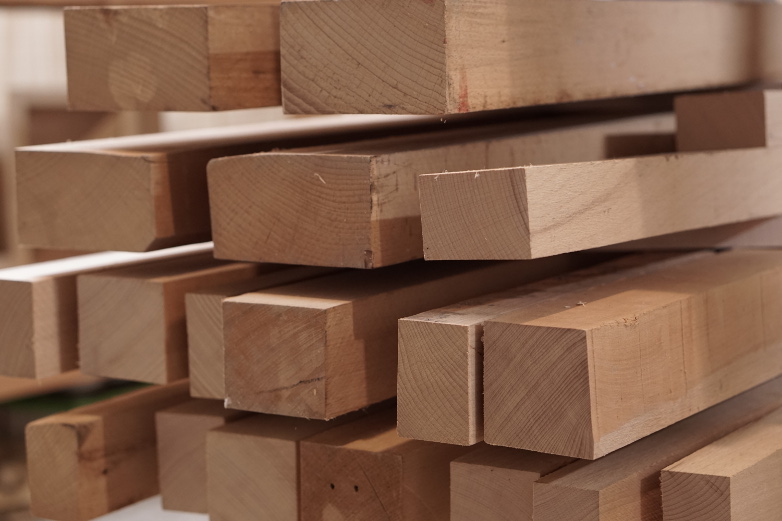
It really pays to have good friends who need more shop space.  My friend asked me if I’d like the left over European beech from his Roubo bench, and I was happy to jump at the chance.  This left-over lumber amounted to over 200 bf.  Most pieces are less than 3 inches wide, but there’s a few wider boards.  Almost all of it us 10/4 and rift-sawn.  There’s plenty of great table/chair leg material in there.  I think I’ll use some of it to make a nice sharpening or joinery bench.  What should I do with the rest?

Never miss an opportunity to snag some quality lumber….even if you don’t have the space.  This is a good reason you should always keep your shop neat and tidy.


Superior Hand Tools: The Bit and Brace

I’ve recently been using my vintage hand brace often.  I’ve discovered that there are many times when I prefer it to a power drill.  As long as your bits are sharp and you use a brace with the proper sweep, it doesn’t need much more physical effort than a power drill.  It’s easy to get crisp, clean holes and it’s a lot of fun to use.  It’s also nice not to have to worry about charging batteries all the time.  Watch the video below to see how easy it is to use a bit and brace.

Music is by ‘Hare and the Hounds’.  They just released their first album.  It’s a good one.  I highly suggest you check it out.

The Fundamentals of Furniture Design: Proportion Part 2

Understanding that the traditional builder focused on proportional design instead of measurement isn’t helpful to the modern designer if we can’t see how he did it.  In this post, we will do just that.

Proportion has three primary objectives: to create symmetry, contrast, and punctuation.  Designers create symmetry in the horizontal: right-to-left.   Symmetry’s purpose is to lead the eye.  Contrast gives life to our designs.  Major and minor elements create harmony instead of competition.  Punctuation gives our designs a distinct beginning and end.  It creates transitions which connect the various elements of our design.

Proportional design creates harmony

Proportion creates harmony


The design above shows that we can use the knowledge the traditional designer provides even for the simple modern designs.  Despite the absence of ornamentation, the design borrows some ques from the classical orders.  A vertical 2:3 rectangle composes the basic form.  The vertical elements transition on a 1:7 scale.  The large scale on the right, dictates the size of the drawer.  The small scale to the left divides the leg into seven sections.  The bottommost section is where the leg taper begins.  The thickness of the other elements, as well as the overhang of the top, are all drawn from scales.  For example, the thickness of the legs is 1/3rd of one module on the right scale.  The drawer-pull placement is 1/3rd the height of the drawer.  The pull placement provides symmetry between right and left.  It drawers the eye to the drawer.  The overhand of the top and the taper of the leg both give contrast and punctuation.

More drama could be created by using contrasting materials.  More complex moldings could be used for the top.  Bands of inlay could be place around the legs at the transition lines.  The possibilities are great.

The important thing to consider is that this very simple design creates harmony between all its elements.  I created it in a very short amount of time with nothing more than a compass and straight edge.  However, it wasn’t my first effort…that was a complete failure.  Get out there and get started.  Don’t be afraid to fail.  Keep at it.  Study the proportions of successful designs.

Fundamentals of Design: Series Index


Roubo Workbench Build: Chopping Mortises by Hand

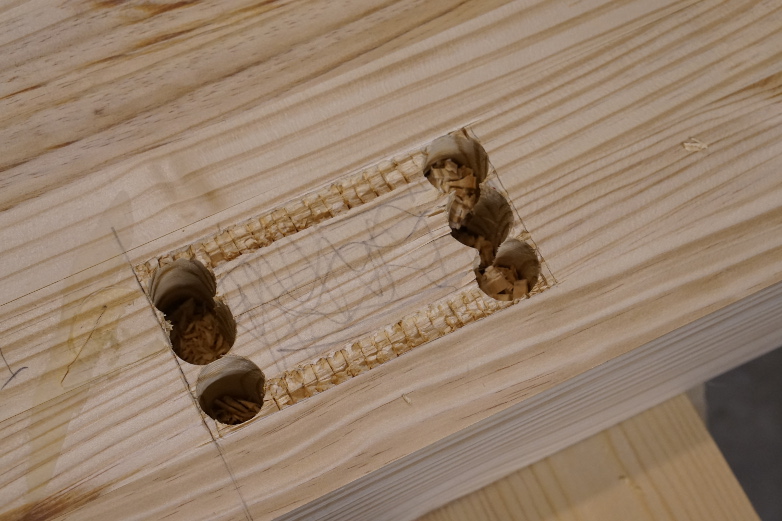
The mortises in the top are huge.  When I say huge, they are caverns of darkness that suck the life force from unsuspecting victims.  They measure two inches wide, by 5 inches long, by two inches deep.  There are four of these soul sucking vampires to slay.  If you want to face these monsters, you’ll need the right weapons.  If you want to see how I chopped these giant mortises by hand, proceed with caution.  I have warned you!

  1. Bit and Brace – check
  2. Large Mortise Chisel – check
  3. Heavy Mallet – check
  4. A healthy breakfast and a good night’s sleep – check

Marking Out

Align your legs web

Align your legs web

Start by defining a line 15″ from each edge of the bench top.  This aligns with the outside edge of each leg.  Next, line up each leg with the line and the edge of the bench top.  Make sure that your alignment is perfect!  Check it twice.

Carefully mark out your mortises with a knife

Carefully mark out your mortises with a knife

With the leg aligned, trace around the tenon with a pencil or marking knife.  I prefer to knife in my line.  Make sure that the leg does not move during this process.  Next, number each tenon and its corresponding mortise.

Define the Edges

Before boring out most of the waste, define the edges with a mortise chisel.  This will give you a nice crisp edge.  It also provides you a bit of insurance.  I failed to do this on my first mortise.  Not even my freshly sharpened Irwin bits could prevent blowout when I hit some funky grain.  My knife lines weren’t deep enough.  Do yourself a favor.  It only takes a minute or two per mortise.

Start with the corners

Start with the corners

Bore Out the Waste

Start with the corners

Start with the corners

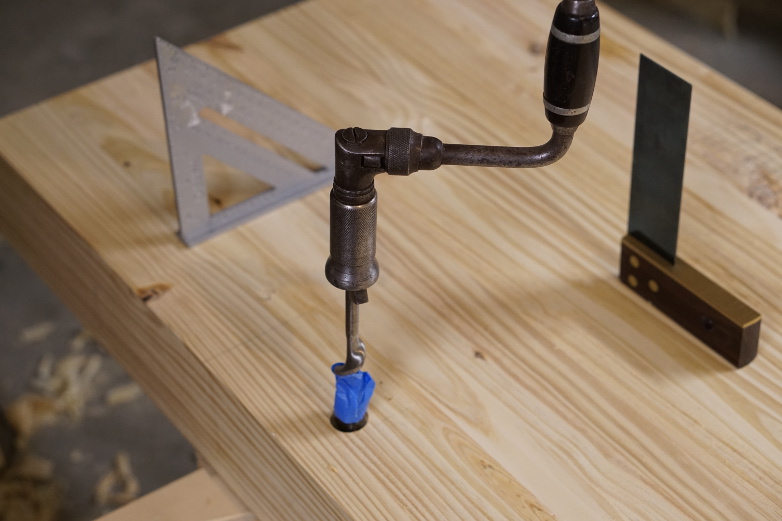
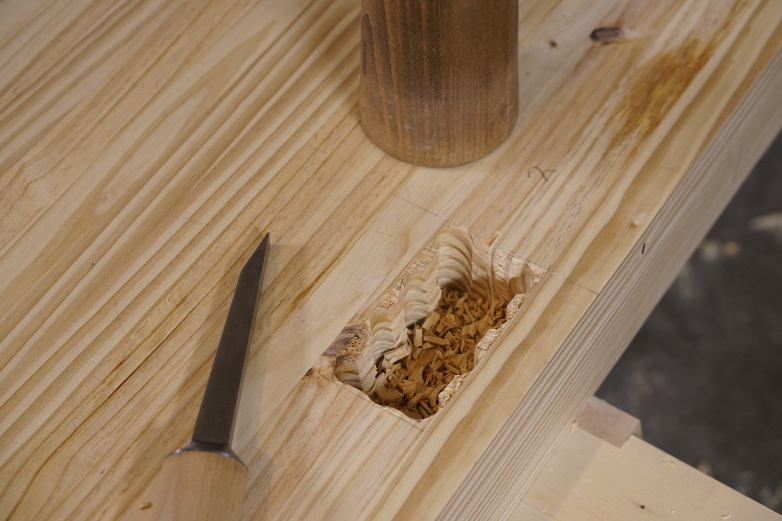
With a large bit, drill out most of the waste.  A depth gauge (painter’s tape) prevents you from boring too deep.  A couple of try squares keep you drilling straight.  Start with the corners and work inwards.  I found that boring out several lines worked best.  Once you’ve drilled out most of the waste, you can knock out the rest with a mortise chisel.  Be careful not to ding up your edges.

All bored out

All bored out

Roughed out mortise

Roughed out mortise

Clean Up

Complete Mortise

Complete Mortise

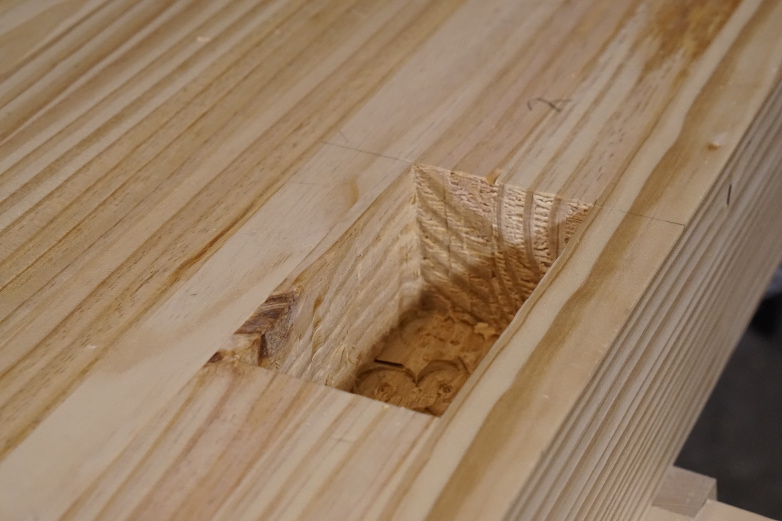
With most of the waste removed, start cleaning up the mortise walls.  I used a large 1/2 inch mortise chisel for the end grain and a bench chisel for the long grain.  Set a try square on the bench top to make sure you are square.  Use a small square to check that your walls stay square.  I used a 4 inch double square that allowed me to check the mortise depth.  If you are shallow, use your mortise chisel with the bevel down to deepen the mortise.  Work from the middle outwards.

Check the Fit


chamferred tenon

Chamferring your tenons will help start them in the mortise

I chamferred the tenons on my legs with a block plane.  This helps start the tenon into the mortise.  Chances are that you will be a little tight on your first attempt.

Test fitting mortise

Not quite there

I suggest removing material from the tenons if you’re tight.  In this case I was able to get the tenon about 3/4 of an inch in the mortise.  I knew that my tenon cheeks were square, so there was interference from the mortise.  I checked the mortise and discovered I had missed some material near one corner.  After some minor tweaking, I was ready to give it another shot.

Mortise by Hand Complete

A Perfect Fit

Presto!  A near perfect fit.

I was a little intimidate by the task.  After the task was complete, I realized the concern was unwarranted.  It really isn’t hard.  It’s just a little time-consuming.

Stay tuned.  Stretchers are next.

You can find links to my other Roubo posts here:  Project Index

The Fundamentals of Furniture Design: Proportion Part 1

Prior to the Industrial Revolution, furniture design and creation were intimately connected.  Furniture makers used whole number proportions to create harmony between their work, nature, and the human form.  Like a symphony, proportion created balance between the micro and the macro.  Unfortunately, the Industrial Revolution shifted priorities.  As machines replaced our hands and eyes, measurements and tolerances replaced proportion and harmony.

Proportion starts with the square and ends with the double square

Proportion starts with the square and ends with the double square

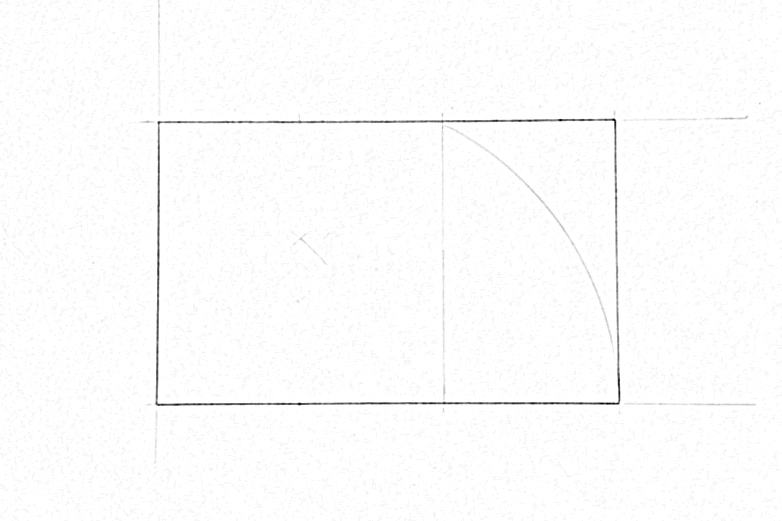
Traditional designers strove for connectedness.  Simple shapes with whole number proportions combine to create complex forms.  Details echo proportions found in the larger form.  This creates a sense of balance between scales.  In the image above, the square proceeds to the double-square, much like a musical octave.  The middle transition creates a 2 to 3 ratio.  With nothing more than a compass and a straightedge, I am able to create any proportion or shape my heart desires; no tape measure or ruler necessary.

You don’t have to stick to traditional in order to create harmony in your designs.

The golden ratio (phi) is found throughout nature.

The golden ratio (phi) is found throughout nature.

The shape above represents the golden rectangle (phi).  While, technically not a whole number ratio, phi (1.61803…) can also be represented by the Fibonacci sequence.  As you progress higher in the sequence, the closer the ratios approach phi (i.e., 89:144 = .61805).  This golden ratio is found everywhere from the spiral of sea shells to the pyramids of Giza.  Designers often turn to golden ratio because it pleasing to the eye.

The Doric classic order

The Doric classic order

The traditional designer spent large amounts of time studying the classical orders.  Above, the Doric order epitomizes the height of classic Greek design.  Often seen without a base, the column height varied from 4 to 8 column diameters.   In this example, the capitals are 1/2 diameter high and 1 1/2 diameters wide.  The classical orders are similar to the keys of classical music.  Each speaks a slightly different language, but each strives to harmonize its elements.  Studying the classical orders can go a long ways in teaching a designer which proportions create balance and harmony.

Take a minute and study a piece of furniture that you find attractive.  What relationships can you find between its height and width?  Do the details echo elements found in the larger form?  What shapes can you find hidden in the overall form?  Repeat the same process with a piece of furniture that you find clumsy or clunky.

Fundamentals of Design: Series Index

The Fundamentals of Furniture Design: The Furniture Design Toolkit

Toolkit Web

What you keep in your furniture design toolkit is a personal choice.  I intend to give you tools that can expand your design experience; not tell you which ones to use or how.

There are two distinct approaches to design: digital and analog.  You can use either effectively.  You can do as I do, and use a combination.  I draw my rough sketches on paper, and polish my designs in Sketchup.  It’s nice to see your designs in three dimensions.  It helps me workout functional issues that are difficult to see on paper.

The Analog Toolkit

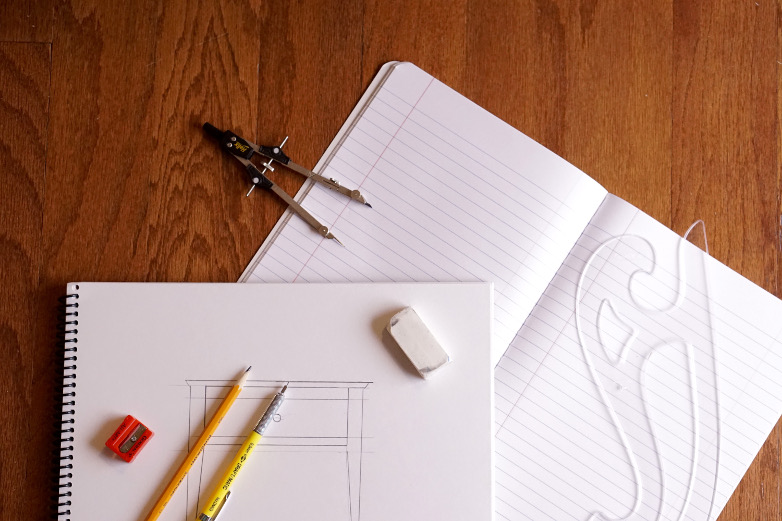
I prefer to start my designs with pencil and paper.  I freehand a rough sketch to capture the basic form.  Then, I refine the form with a straightedge and compass to produce a 3-view orthographic projection.  While I complete my designs digitally, you are free to finish them on paper.  If you prefer the analog route, there are some tools you’ll want to keep nearby.

Paper and pencil are obvious.  I prefer a sharp #2 and a spiral bound notebook for my rough sketches.  For my 3-view drawing, I like a 16-20lb paper and a set of Draft-Matic mechanical pencils.  You’re free to use whatever pencils you like, but make sure you keep them sharp.  You’ll also want a soft white eraser, eraser shield, and dust brush (don’t use your hands).

You can create any shape with no more than a straightedge and compass, but that takes skill; something we will dive into later (there are excellent exercises in Sacred Geometry: Philosophy and Practice).  However, it’s nice to have a few angle templates and a T-Square.  You’ll also want a compass and at least one divider.  A set a French Curves are nice to have.  You can typically find a complete set for around $10.  If you really want to splurge you can purchase a parallel sliding rule (I plan to purchase one soon).

The Digital Toolkit

If you prefer digital, then you’ll need to get acquainted with some 3D modeling software.  SketchUp is what I use.  It’s free and easy, but there are license restrictions.  There are many others, but you’ll find the Sketchup’s community is growing very quickly.

Whatever you use, get familiar with software as quickly as possible.  Buy a few training books.  Search Google.  Look for resources on YouTube.  Rob Cameron has a great website if you’re using Sketchup: SketchUp for Woodworkers.

Whether you decide to go analog, digital, or both, get out there and start practicing.

Next up, Proportion.  Stay tuned.

Fundamentals of Design: Series Index
Roubo Workbench Build: Leg Tenons the Hybrid Way – Video

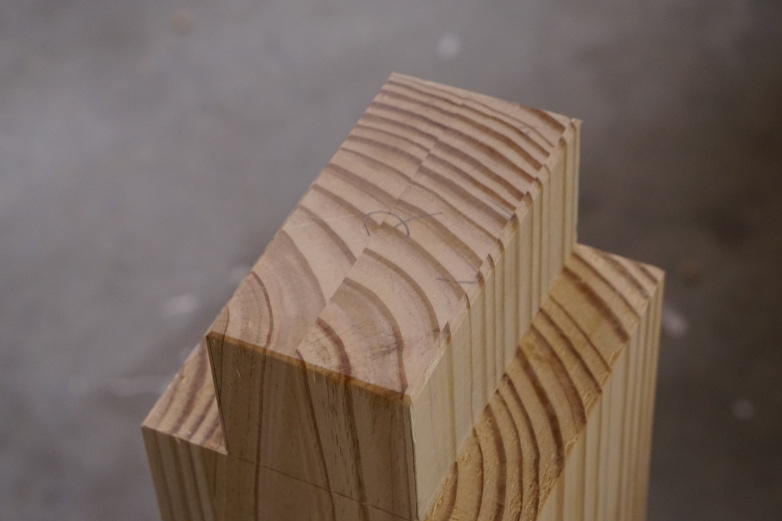
I intended to demonstrate cutting the large leg tenons for the Roubo workbench build two different ways: by hand and with the aid of a band saw.  Unfortunately, my camera shifted while I was cutting the tenon cheeks.  Consequently, you’ll only get to see my poor cross-cutting skills today.

Marking Out

I like to start by marking out my shoulders.  I prefer to do this using a square against the long grain, as opposed to using a cutting gauge against the end grain.  I get more consistent results.  I hold the square using my thumb against the stock and one or two fingers on the blade.  Make sure that you draw straight back with your knife.  Start with one or two light cuts, and gradually increase pressure.  Flip your piece, place your knife in your previous line, reference your square off of your knife, and repeat.  Always make sure that you are referencing your square off of your face or face edge.

Once I have my shoulders marked out, I move on to the cheeks.  I use a simple wheel gauge for the cheeks.  I set the fence and give it a couple of quick passes for each side.  There really isn’t much to describe here.  When I’m finished, I like to darken all of my lines with a mechanical pencil.

Cutting the Shoulders

With the marking out-of-the-way, I move on to the shoulders.  In the video above, I am using a small backsaw.  Before I start sawing, I make a little trench on the waste side of my work piece with a chisel.  This gives my saw a little groove in which to ride.

I start by drawing the saw back a few times.  This deepens the groove, and helps ensure I stay on track.  Next, I take a few light passes on the far corner, and lower the saw plate until I’m taking cuts across the entire width of the leg.  At this point, I saw down to the baselines at the corners to make sure that my cut stays square.  I finish the cut by removing the triangle left in the center.

Cutting the Cheeks

This is the easy part.  I believe this is the best way to cut tenons.  If you have a band saw and haven’t given it a try, what are you waiting for?  Simply line up the fence to the waste side of your line, and go.  Cut down to your shoulder line, flip and repeat.  It’s fast, easy, and produces a nice square cut (assuming you set up your band saw properly).

Cleaning Up

With the waste removed it’s time to start cleaning up the shoulders.  The band saw produces square cheeks right off the saw.  I will mark the mortises directly from the tenons.  There is no need for them to be identical, only need square.

Use a chisel and deepen your knife line on all three sides of your shoulder.  Then, take over-lapping passes from on side to the other using your knife line as a reference.  If you’ve left too much waste, you might have to take a couple of passes.  It’s easier than trying to remove 1/16 or more in a single pass.  Check your work with a small square.  I undercut mine by a few thousandths.

Stay tuned.  Mortises are next.

You can find links to my other Roubo posts here:  Project Index

Music: Good Old War – My Own Sinking Ship

Fundamentals of Furniture Design: What is Good Design?

Good design doesn't have to be complex

This simple design, uses many proportions commonly found in nature

Good designs are often beautiful but, design is so much more than that.  A well designed piece of furniture is not only beautiful, it is also functional.  It serves a purpose and serves it well.  The best designs are unique and establish style.  In this post, we will look at the elements of good design and examine them in detail.

Beauty

“You can’t please all of the readers all of the time; you can’t please even some of the readers all of the time, but you really ought to try to please at least some of the readers some of the time” – Stephen King, On Writing

I really love this quote, and I think it applies here.  Beauty is a very personal thing.  I can’t tell you what that means but, if you’re the only one who finds your designs beautiful, you aren’t succeeding as a designer.

Good designs tend to have elements commonly found in nature.  The most revealing thing you can do, is examine a piece that you find beautiful.  Break every element down and look at it under a microscope.  Look at the proportions.  What textures are used?  How did the designer incorporate negative space?  What about color?  Can you find a relationship between any of these elements and those found in nature?  What is it about each element that you find attractive?

If you want to design successfully, the examination process is critical.  Do it every day.  Take notes.

Form

Webster’s describes form as, “the shape of a thing or person”.  The elements of form include, but are no limited to: shape, negative space, color, texture, size, and density.  Good form seeks to find balance or display contrast.  Your design will determine the shape, size, density, and negative space.  Wood selection and finish will determine color and texture.

When inspecting the elements of your design, you must ask yourself if it achieves your goal.  Do the proportions of the legs achieve balance with the thickness of the top?  Does the contrast between wood species create the desired effect, or is it too busy?  Try to recreate the elements you find attractive in other pieces.

Function

Furniture without function is useless.  It doesn’t matter how aesthetically pleasing the item is.  Function is the most important factor in determining the success of design.  Seek to make your designs functional before making them beautiful

When building a dining table, make sure that it is the proper height.  When designing a chair, make sure that it is sturdy and comfortable.  Do your drawers slide freely?  Will doors open properly?  You get the idea.  It’s not rocket science, but you must not overlook anything that may hinder the design’s purpose.

Don’t forget the details.  Groves and seams in tabletops are notorious for hiding crumbs.  Dark woods and stains show dust.  Soft woods scratch easily.  Be thorough.

Style

Style is the most personal element.  It sets your designs apart from the others.  It makes your designs unique.  It’s also the element that takes the most time to develop.

Establishing style can be as simple as incorporating a unique detail into all of your pieces.  Perhaps it’s a molding or drawer pull.  It can be subtle, such as consistent use of negative space.  It can be bold, like the sculpted chairs of Sam Maloof.  Whatever it is, it’s likely something that will take some digging to get out.  You won’t uncover it over night.  Keep working.  Keep discovering what it is that makes you unique.  Look for inspiration everywhere.

What do you think makes a design successful?

Next up, we’ll look at the designers toolkit.

Fundamentals of Design: Series Index