Blood, Sweat, and Sawdust

Going against the grain

Month: September, 2016

The Workshop Build: Lessons Learned

No matter how well you plan, there will always be things you’ll wish you’d done differently.  So, I’m here to share a few things I wish I’d done differently with my shop build.

Completed Workshop

Wall Space

Wall space is sacred.  If you’re limited on space, plan the locations of outlets and ducting carefully.  Make sure you have enough uninterrupted wall space for lumber storage.  I ended up with a few duct drops I wish I planned more carefully.  So, carefully catalogue everything you plan to store on the wall.

Headroom

Maintain as much headroom as possible.  There are one or two spots in my shop where I constantly hit my duct runs with lumber.  Why I didn’t run the ducting 6 inches higher, I’ll never know.  I will raise everything in the future as time allows.

Electrical

Don’t skimp on electrical.  Determine how many receptacles you need and then add 50%.  I thought I had planned for sufficiently, but I already wish I had more.  It’s always easier to do it all at one time.  In my case, it will be much more difficult to add any electrical now that the drywall is up.

What I did Right

  • Storage – I have plenty of it considering the small size of my shop.
  • Lighting – I installed plenty of efficient LED light fixtures.  So, there isn’t a dark corner in the shop.
  • Efficient Design – Placing my tablesaw and jointer in the center of the shop made for efficient movement around the shop.
  • Dust Collection – Dedicated ports keep me from disconnecting/reconnecting machinery and save time.
  • Air Conditioning – A comfortable shop ensures that I am able to work year round.  Installing it myself, saved me lots of money.

The Tree Journal – American Beech (Fagus grandifolia)

Fagus grandifolia is more commonly know as American Beech.  It grows quite large, and produces excellent lumber.  You will find fagus grandifolia as far north as southern Canada and as far south as northern Florida.  However, you will rarely find it west of the Mississippi river.

Description

American Beech typically reaches heights between 60 and 120 feet.  It produces dark-green leaves with an oval shape.  The leaves are sparsely toothed and 2.5 to 5 inches in length.  In the fall, the leaves turn apricot and are reluctant to fall.  In fact, the leaves often remain throughout the winter.  American Beech is monoecious, which means that it produces flowers of both sex.  In the fall, it produces small nuts in pairs.  These nuts have a distinctive, spiny husk.  One interesting thing about Beech is that it reproduces via root sprouts as well as seedlings.

Beech prefers shaded areas.  You will usually find it in forests and along trails.  Additionally, it sets itself apart from other trees by its distinctive bark.  The bark is silver-gray and very smooth.  In fact, hikers often target the tree as a canvas for carving initials.


Use for Woodworkers

American Beech is straight grained with a pale-cream color.  It is diffuse porous with a fine to medium texture.  Though hard, Beech is perishable and susceptible to infestation.  Beech responds well to steam bending.  However, it moves quite a bit with fluctuations in humidity.  Additionally, Beech is quite affordable due to its wide availability at lumber yards.

Although it makes great lumber, Beech is a go to wood for tool makers.  In fact, its cousin, the European Beech, has been the preferred wood for mallets and workbenches for centuries.

IMG_5696

Stay tuned for more of the Tree Journal.

The Tree Journal Index


A Bench Crafted Moxon Vise

While building my tool cabinet, I discovered a major issue with my workbench.  It sits too low for detailed work.  After several nights of dovetailing, I began to develop a back ache.  I needed something that would bring my work closer to my eye.  I needed a Moxon vise.

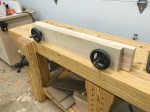
A Moxon vise is a twin screw accessory vise that sits on top of your workbench.  Joseph Moxon described such a vise in his quintessential “Mechanick Excercises”.  As a result, others started referring to similar devices as “Moxon vises”.  The vice fastens to your benchtop using holdfasts or clamps and is stored below the bench top when not in use.  Since, I’ve been very happy with my Bench Crafted leg vise hardware I decided to give their Moxon vise hardware a shot.  The Bench Crafted Moxon vise hardware consists of two handwheels, two acme screws, four nuts, and a nice piece of suede.  Everything in the kit exudes quality.

The Build

First, I milled up some 8/4 ash for the jaws and stabilizer.  Then, I drilled a counter bore in the fixed jaw.  The counter bore will receive one of the large nuts.  Next, I drilled the hole for the acme screws.  Then, I drilled elongated holes in the moveable jaw and attached a stabilizer to the back of the fixed jaw.  That’s it.  The basic build is very simple.  However, give me enough time and I will overthink everything

Instead of the basic square mortise for the nut, I decided to try a cleaner, hexagonal mortise.  To start, I made my counter bores slightly smaller than the provided nut.  This allowed me to thread a nut onto one of the acme screws and place the nut over the counter bore.  Next, I traced the nut on to the fixed jaw using a marking knife.  Then, I chopped out the corners with a sharp chisel.  I think the results speak for themselves.

Additionally, I decided that I wanted a nice bevel on the front of the movable jaw.  And, what better compliments a stopped bevel than a lamb’s tongue transition?  To create the lamb’s tongue transition, I started by making a template.  Then, I used the template to mark out its location.  From there, I used a carcass saw to sever the grain at the transition.  Then, I simply hogged out the waste with a chisel and mallet.  Finally, I cleaned things up with a rasp and sand paper.  I over cut in a few areas, but I think this turned out well for my first attempt.

I hate contact cement.  So, I searched for an alternative.  During my search, I discovered adhesive cork board.  My local Home Depot carried it.  So, I decided to give it a shot.  I only attached the cork to the inside of the movable jaw, but I think this will be sufficient.  It’s easier to apply than suede and without the noxious fumes of contact cement.  Finally, I applied a few coats of shellac and wax to the outside faces of the vise.  I’m very happy with the results.  The Bench Crafted Moxon vise hardware does not disappoint.

Review – The Lie Nielsen Honing Guide

Sharpening is not my favorite task.  I prefer working wood to working tools.  However, now and then you need to grease the machine.  I’m always looking for ways of speeding up the process, so that I can get back to work as quickly as possible.  As a result, I’ve purchased a few sharpening jigs throughout the years.

First, it was the Veritas MKII.  It’s a nice jig, but it has a couple of major weaknesses.  Your blades can skew during use, and using the registration jig slows down the process.  So, I sold the MKII and purchased a cheap Eclipse-style side-clamping jig.  This solved the problem of blade skew and worked well for most plane irons.  However, it never held my chisels square and was poorly made.  I kept the Eclipse, but purchased a Kell honing guide for my chisels.  The Kell jig is beautiful and works well for chisels.  Unfortunately, it is difficult to hold with certain blades.  Additionally, it required two different setups for chisels and plane irons.  Enter the Lie Nielsen honing guide.

img_9405

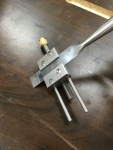
At first, I hesitated to give it a shot due to its price.  At $125, the Lie Nielsen honing guide is pricey.  Lie Nielsen offers several additional “jaws” to support many different tools.  However, each set costs an extra $25 to $35.  Despite the price of admission, I gave it shot.  I also picked up a pair of their long jaws for use with short irons such as those found in spokeshaves.

The guide comes packed in a small, clear plastic box with a set of instructions.  The box makes a great place to store the guide out of the elements.  So, I kept it.  Everything on the guide is well made.  Lie Nielsen machines all the parts, the bearings roll smoothly, and there is absolutely no slop.  In use, the guide proves comfortable to use with all of my tools.

So far, my favorite thing about the guide is that there is only one slot in the jaws.  I use stop blocks to quickly set the honing angle for all of my tools.  So, I now I use the same set of stop blocks for all my tools.  The jig feels like it’s on rails when in use.  However, the narrow wheel allows you to create a cambered edge if that’s your goal.  I might be mistaken, but I believe I am able to pull a burr on a dulled edge more quickly with this jig than with others.  If correct, I attribute this to the tight tolerances to which Lie Nielsen manufactures the guide.  Finally, while the various accessory jaws are nice, they do require some fiddling.  It takes a few minutes to swap them out.

In conclusion, the Lie Nielsen honing guide meets all of my requirements.  It easily bests all the other honing guides I have used in the past.  The time and frustration it saves me while sharpening justifies its hefty price.  In fact, it has probably already paid for itself.


The Tree Journal – American Persimmon (Diospyros Virginiana)

Diospyros Virginiana

Diospyros Virginiana is more commonly known as American Persimmon.  It is found throughout the eastern United States and as far west as Texas.  Additionally, humans have cultivated its fruit and wood since prehistoric times.  I often find these trees at the edges of fields in small groups.  The trees in my area usually reach no more than 30 feet in height.

Description

American Persimmon is a small tree, usually reaching no more than 20 meters in height.  It has a slender trunk with dark brown or grey bark which is usually divided into thick plates.  Oval leaves alternate and are generally four to six inches long.  In the spring they are dark green, but tend to develop splotches in late summer or early fall.  During the fall, the leaves turn orange or scarlet.  In fact, persimmon leaves are often the first to drop during the fall months.

Diospyros Virginiana is dioecious.  This means that each plant is either male or female.  At least one plant of each sex must be present to produce fruit.  The tree usually produces small white flowers in May or June.  If pollination occurs, the tree produces berry-like fruit containing one to eight seeds.  The fruit starts pale orange and often migrates towards a brown color after freezing.  When green, the fruit is extremely astringent.  However, ripe fruit is very sweet and quite delicious.   When ripe, the fruit is soft with a thin skin.  Inexperienced foragers might mistaken ripe fruit for having gone bad.  I find that if the fruit falls from the tree with a gentle shake, it is usually ready to be eaten.

Use for Woodworkers

American Persimmon is semi-ring porous with straight grain.  The sapwood ranges from white to pale yellow-brown.  Since the tree is mostly sapwood, consider it to be perishable and susceptible to infestation.  Despite this, the wood is hard and dense.  Consequently, it is often used in golf-club handles, tool handles, and other turned objects.  Unfortunately, it is not widely available at lumber yards, so prices are usually high.  However, small blanks can often be found at retailers for turning.

Stay tuned.  I will detail another species in a week or so.  In the meantime, don’t hesitate to let me know if you have a tree you would like me to detail.

The Tree Journal Index


The Tree Journal

The Tree Journal

I have wanted to start a tree journal for some time.  So, I am finally getting around to doing just that.  Consequently, I will write a new post every week spot-lighting a specific species of tree.  My goal is to educate myself.  However, I hope I will help some of you as well.

In each post, I will detail the tree’s description and their specific characteristics for woodworking.  Most trees will be ones that are locally available to me in the southeastern region of the United States.  Additionally, I will provide a link to each article below.  So, this page will serve as a sort of index.

Stay tuned for more.  If there are any trees you would like detailed, don’t hesitate to let me know.

Missing the Woodworking in America Action

I planned on attending Woodworking in America this year.  It was high on my priority list.  Unfortunately, it just wasn’t in the cards.  I spent all my coin (and then some) on the shop build earlier this year.  I don’t regret a thing.  Maybe, I will make it next year.

Fortunately, I get to spend the morning with my best buddy.

img_1196

To all my friends attending: have fun, be safe, and bring me back something!

A Hand Tool Cabinet: Finishing Touches

Fertig.  Finito.  Terminado.  The tool cabinet is finished.  Well, it’s not finished finished.  It’s good enough for now.  I need to make drawers for the plane gallery and a few more tool holders.  However, I have completed the majority of my checklist.  In fact, most of my hand tools are now in the cabinet.

Plane Gallery

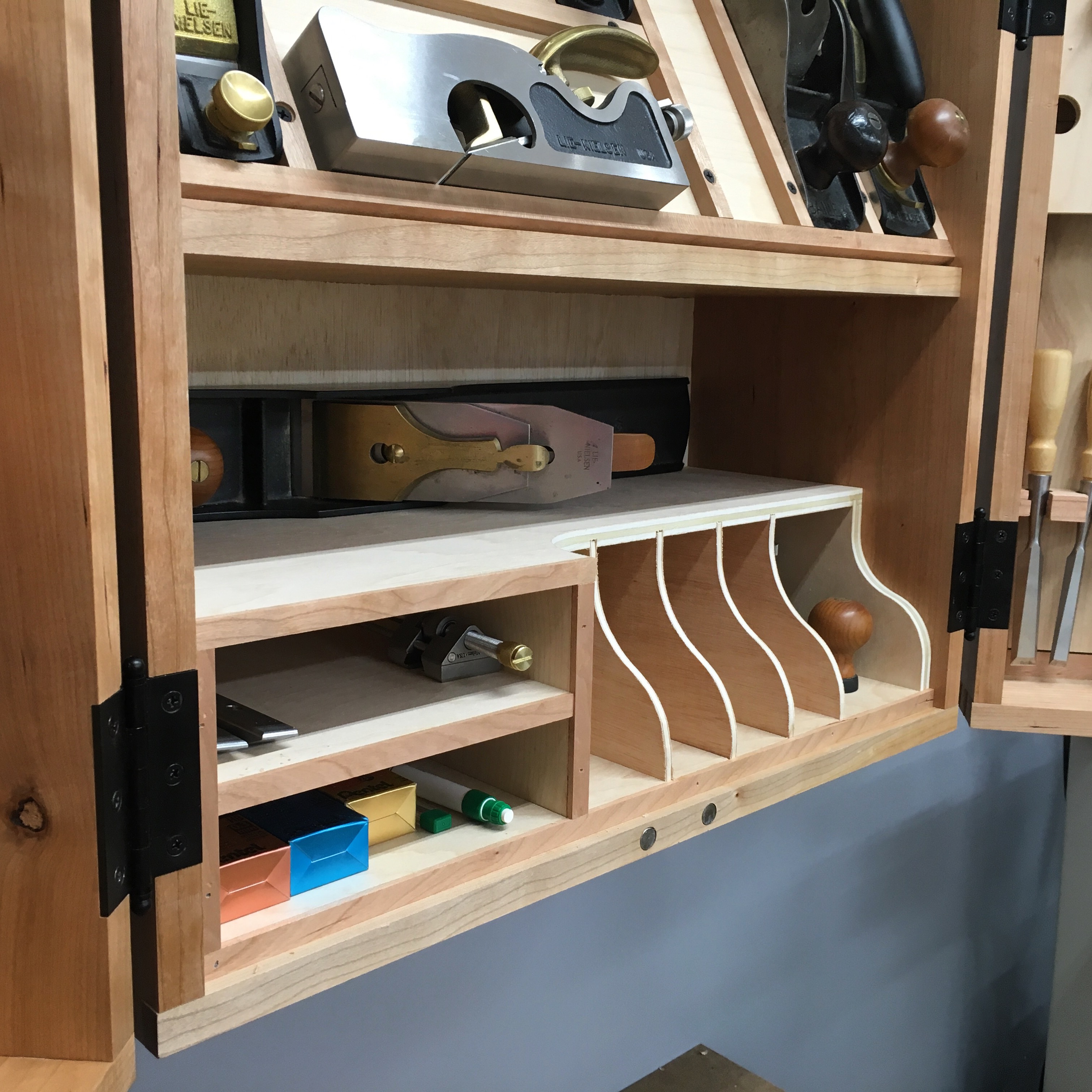
Since my last post, the only big item I needed to complete was the plane gallery.  I made the gallery from half inch birch plywood and faced it with cherry trim.  I recessed the top towards the right side with a gentle curve.  Additionally, the gallery dividers curve to sit flush with the top.  This allows you to easily remove items from each bay.  One day, I will make drawers for the two vertical bays on the left.

Aside from the plane gallery, I built a few more tool holders.  You can see them in the image below.

Completed Tool Chest

That’s all for now.  Although, I may write one more post detailing the drawers.

I will build a Moxon vice using Bench Crafted’s hardware for my next project.  So, stay tuned.

For my previous post on this project click here: Tool Holders and Interior Doors


A Hand Tool Cabinet: Interior Doors and Tool Holders

The main cabinet and doors are complete.  That means it’s time to finally move on to tool storage.  But first, I need to make some interior doors.  The interior doors provide additional tool storage.  And, unlike the main door boxes, the interior doors are simple to make.

The interior doors are nothing more than a hard-wood rail and plywood panel.  The hinges mount to the the rail, and additional tool holders mount to the plywood panel.  The plywood panel is rabbeted into a groove in the rail.  It’s dead simple.  However, I did hand cut mortises for the hinges.  This added some complexity, but it looks nice and adds strength.

I mounted all of the interior doors to cleats.  For the door boxes, I made a long thin cleat.  Then, I used a spacer to mounted it to the side of the door box.  Up top, I made a small shelf, and mounted the cleat to the shelf.  Here, the cleat is wide.  This prevents any tools handing on the doors from hitting the side of the case.  Finally, I installed magnets to the case and screws to the door panels to act as a door catch.

With the interior doors complete, I moved on to tool holders.  I made a nice start, but haven’t finished them all yet.  Tools like chisels and squares are easy, while others are a bit more complicated.  For example, my marking gauges are proving a bit more difficult.  Stay tuned to see how I tackle this.

Aside from a few tool holders, the only thing left to built is a plane gallery at the bottom of the main case.

Don’t forget to check out my previous post: Hand Tool Cabinet Doors

For the next post in this series, click here: Finishing Touches