Blood, Sweat, and Sawdust

Going against the grain

Category: Roubo

Roubo Build: How to Joint Wide Edges Dead Square

Jointing the wide edges of the beams that will be used for the Roubo benchtop

Jointing the wide edges of the beams that will be used for the Roubo benchtop

Jointing wide edges can be tricky. Fortunately, I did my research. It was time consuming, but not difficult.  If I can do it, so can you.

Before you joint an edge it’s important that you establish a reference face that is flat, straight, and free of twist. I covered how I accomplished this here: Milling the large beams for the Roubo bench top

Once you’ve established a reference face, it’s important to assess the board.

  • What are the major defects?
  • Is there any significant bow along the length?
  • How out-of-square is the edge?

I don’t worry too much about minor cupping. This will be remedied, by running both sides through the planer.
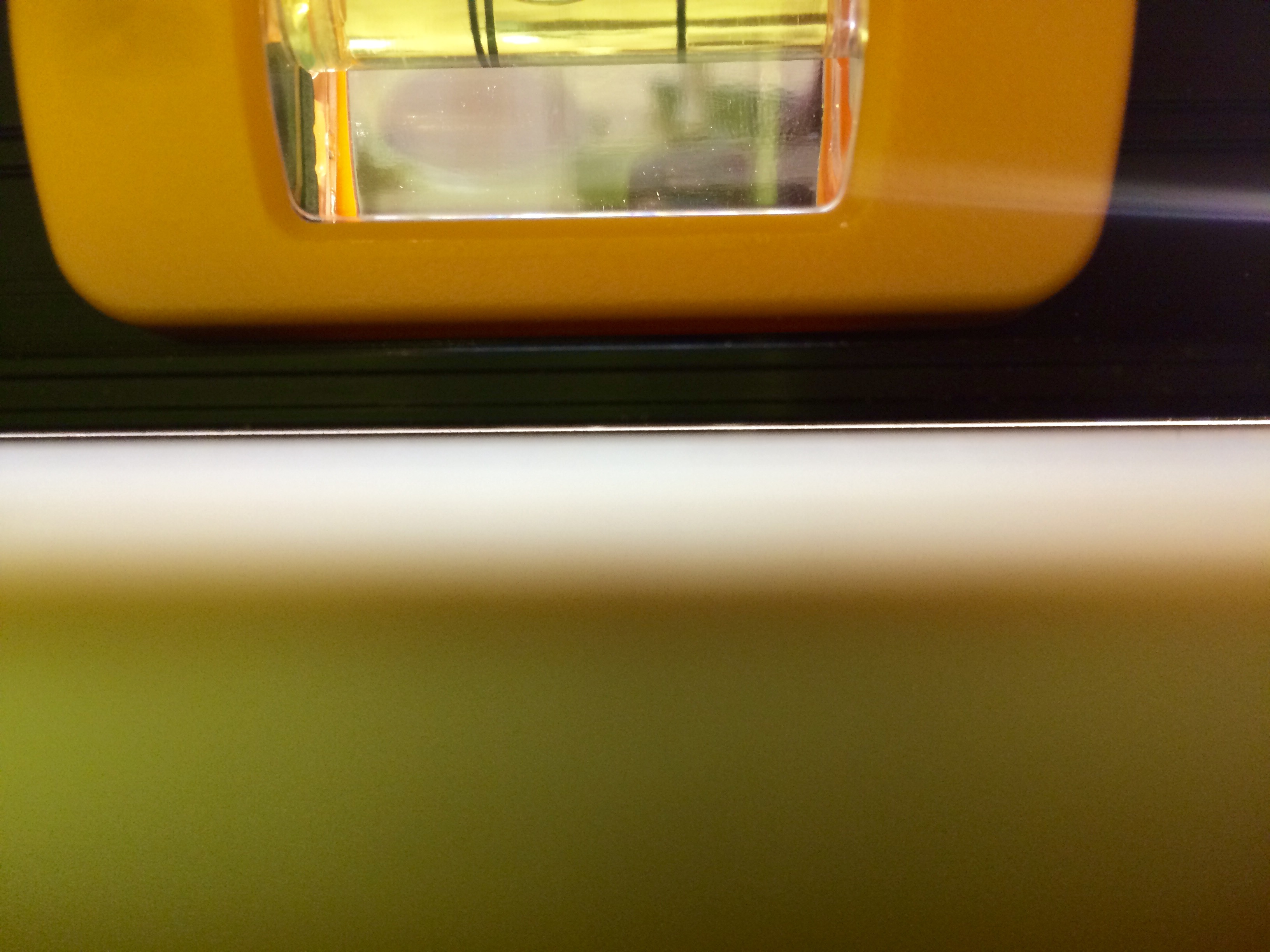
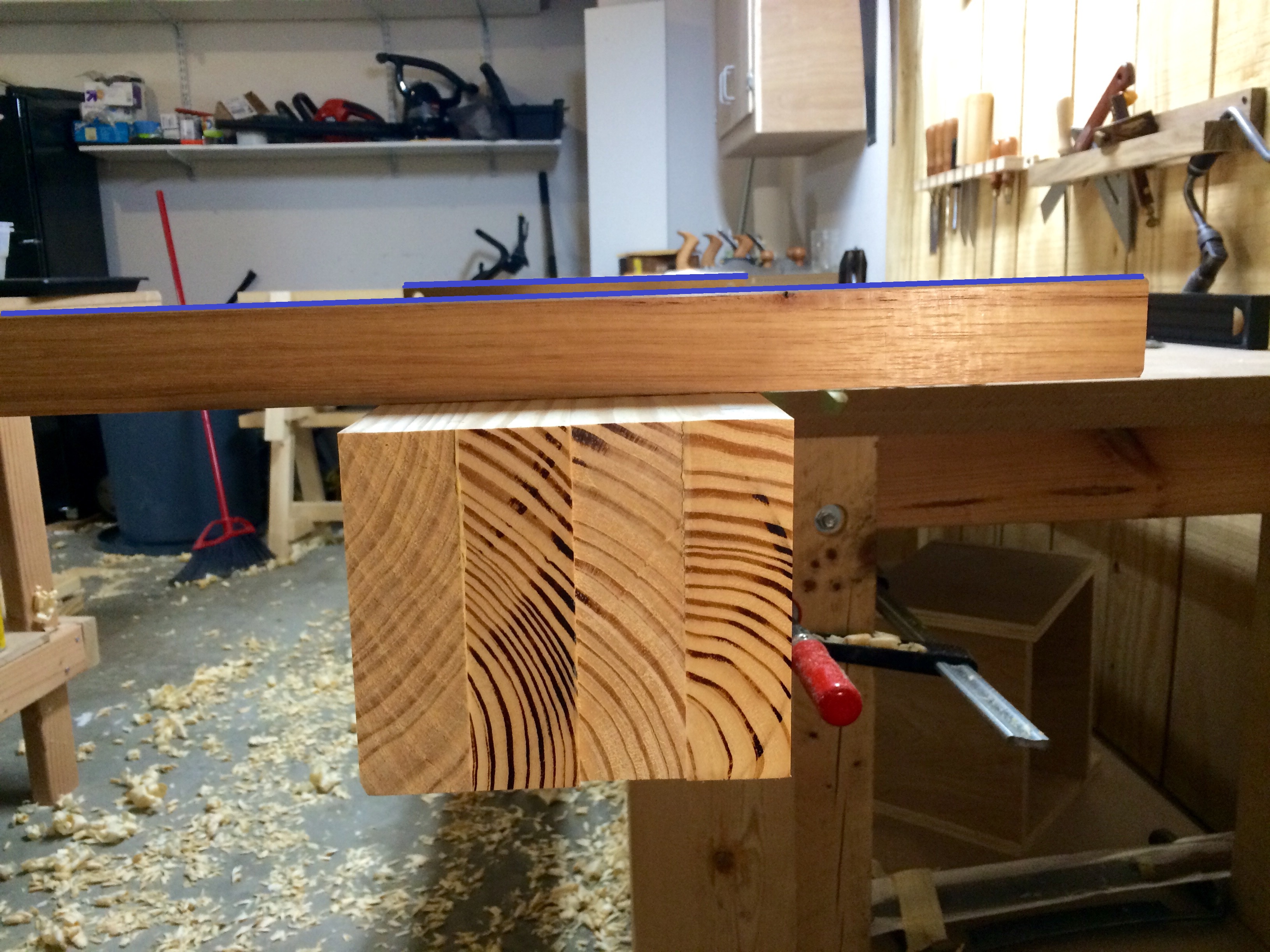
Checking for straightness along the length of the beam

Checking for straightness along the length of the beam

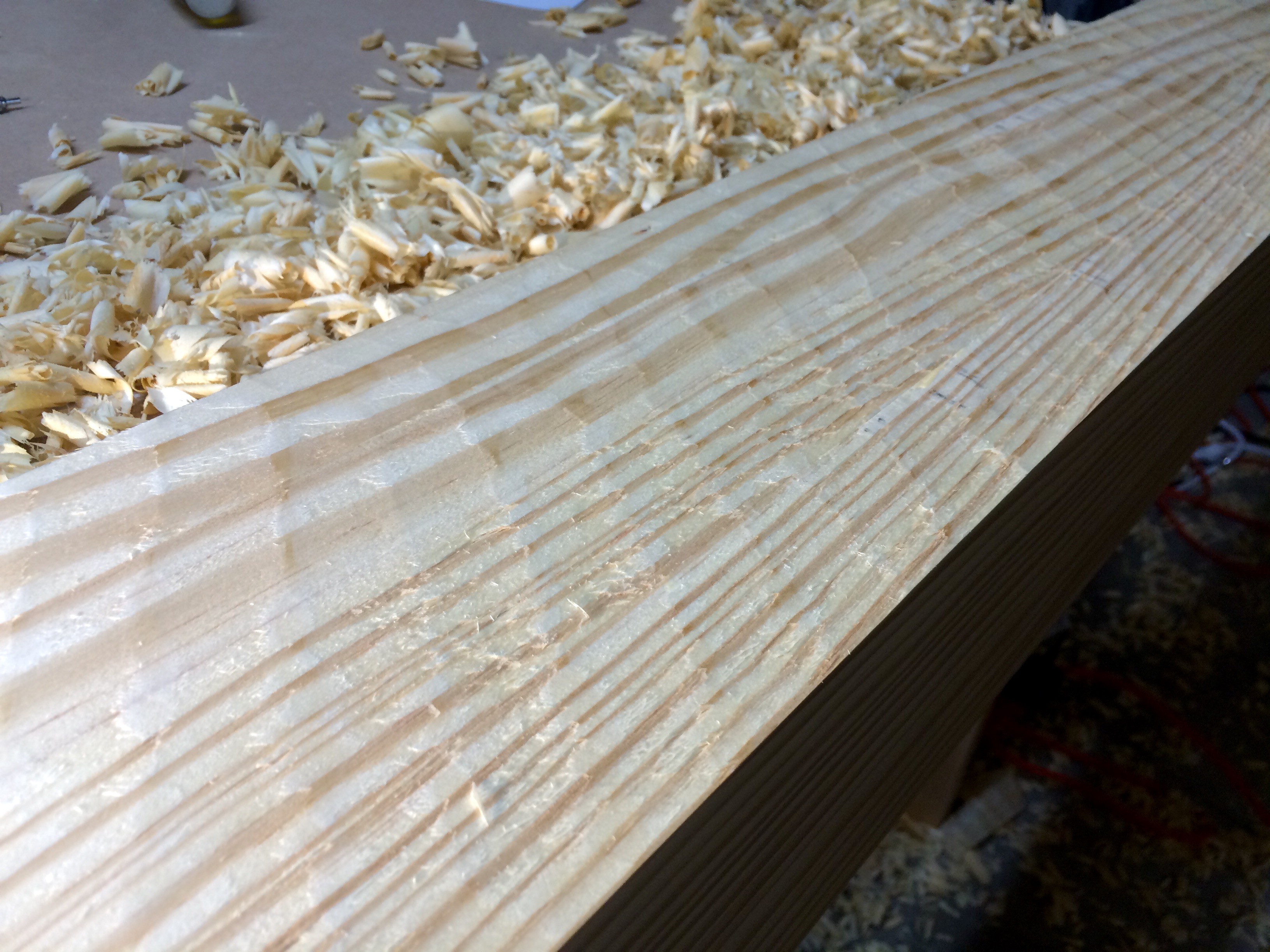
In my case, there was some significant bowing. I measured about 1/16th of an inch in the middle of the board using a 48 inch straight edge. The edge was also significantly out of square. I chose to tackle the bow first. I removed the high-ends of the board by taking overlapping diagonal passes with my No. 7. When I was close, I started taking overlapping passes along the length of the board. Start from the outside and work your way towards the center of the board. I continued until there was less than 1/64th of error.

When jointing along the length, take overlapping passes starting from the outside

When jointing along the length, take overlapping passes starting from the outside

With the bow removed, I started working on getting the edge square to my reference face. I reassessed the board and mark the low spots with a pencil. Take a shaving from each edge, being careful to avoid your pencil marks. Then work your way inwards taking full-length shavings. Reassess the board every couple of passes. If you’re lucky, one side will be high for the entire length of the board.

Checking for squareness of the edge using the face as a reference
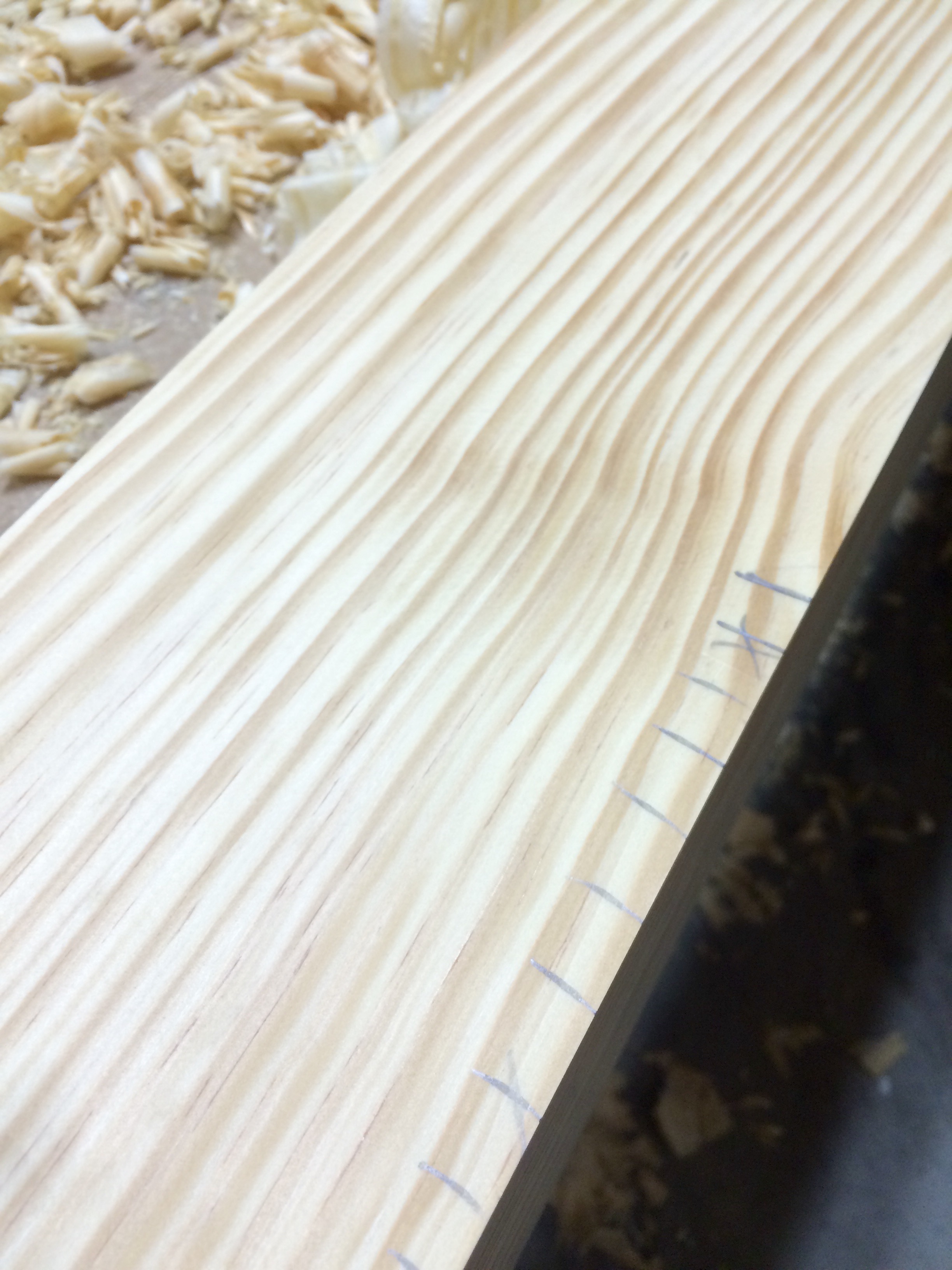
Checking for squareness of the edge using the face as a reference

Stop planing just before you reach your low marks

Stop planing just before you reach your low marks

In my case, the board was square for the first 6 inches on one end, high on the right side throughout the middle, and high on the right side for the last 6 inches. Here is how my routine went.

  1. Take a stopped shaving on the left side until I reach my low spot.
  2. Take another shaving on the left starting just after my low spot on the far end
  3. Take a stopped shaving on the right until I reach my low spot on the far end.
  4. Work my way towards the middle with full length shavings.
  5. Reassess the board and repeat
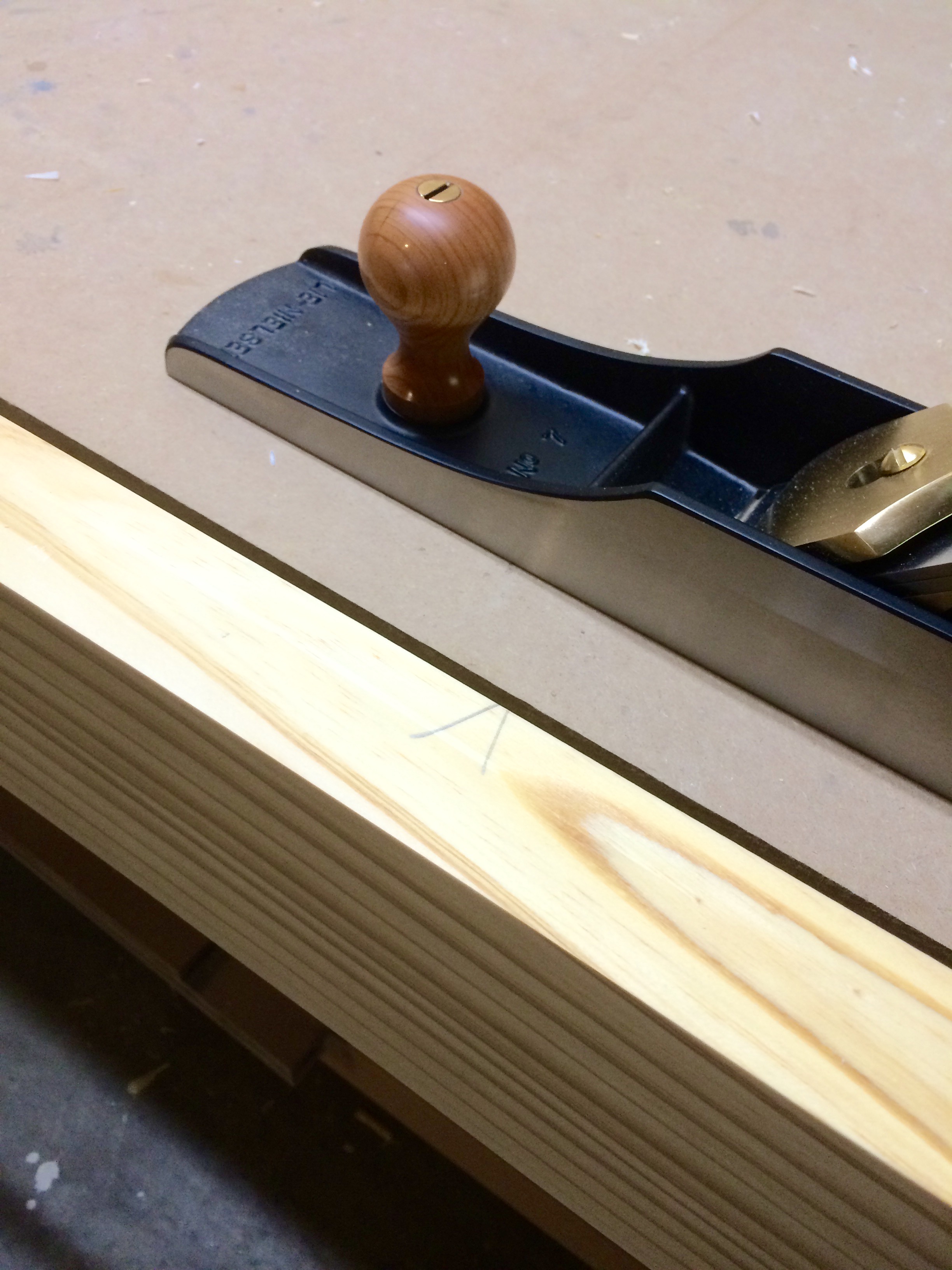
Mark out your edge with an arrow that points to your reference face once you achieve a square edge

Mark out your edge with an arrow that points to your reference face once you achieve a square edge

It sounds complicated, but I can assure you it’s not.  Just go slow and check your work frequently.  Don’t hesitate to ask any questions.  Feedback is welcome!

You can find links to my other Roubo posts here:  Project Index
Crap Wood for Good Workbenches

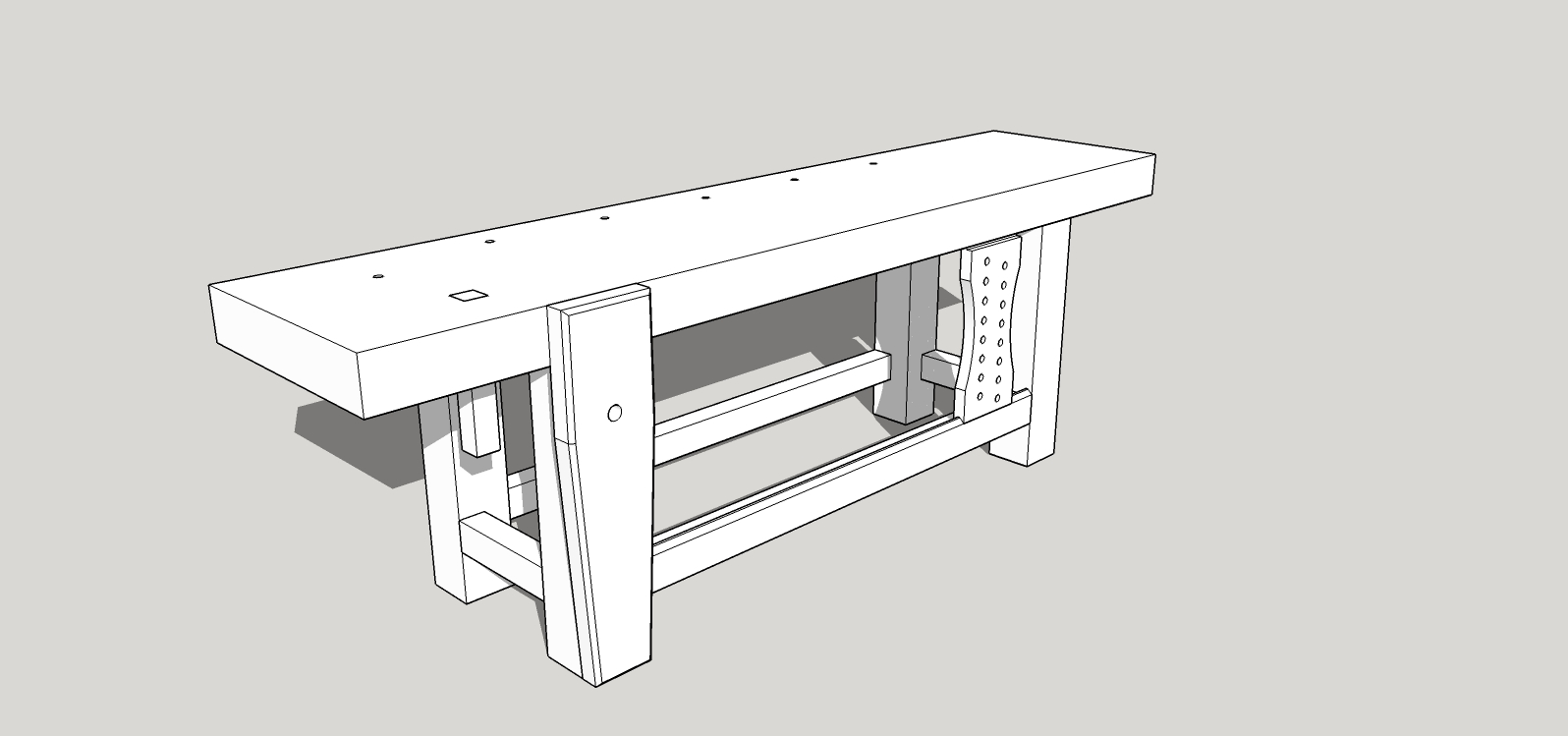
I think that anyone interested in building a Roubo should seriously consider yellow pine. I found this post from Christ Schwarz immensely useful in selecting the very best lumber from your local Borg. Build a great bench without breaking the bank.

You can find links to my other Roubo posts here:  Project Index
Roubo Design Update: What I Learned

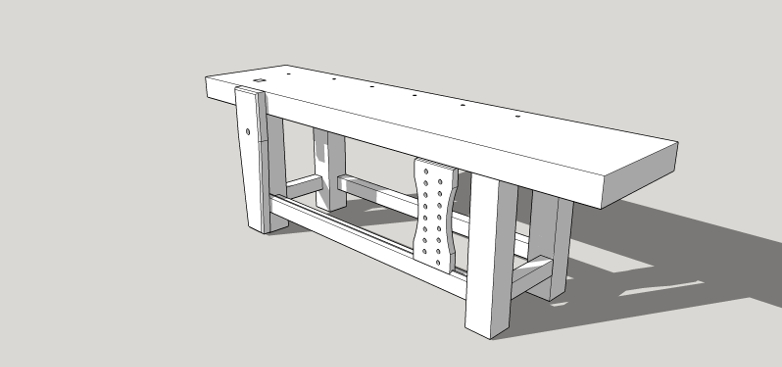
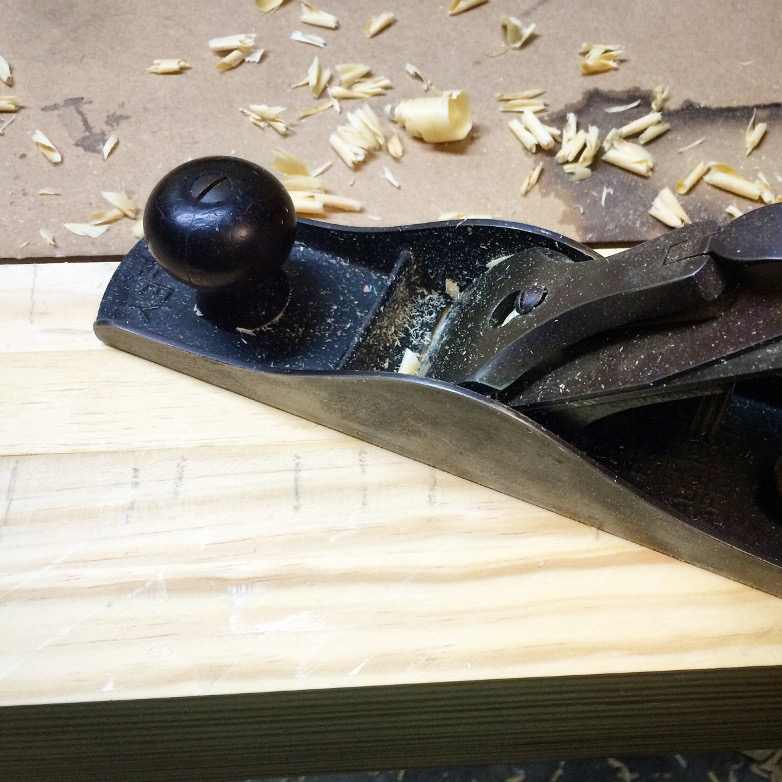
Roubo Sketchup

The design is complete.  The bench top might be taking longer than I’d like, but at least I was able to finalize the details.  Does anyone want to donate a powered jointer?

I had a few minutes over my lunch break, and was able to finish the sliding dead-man, bang out a vise chop, add a planing stop, and locate my hold-fast holes.  It might not seem like a lot, but here is what I learned.

  1. Planning out all of the details will help you work out problems you might not see otherwise.
  2. I don’t really need bench dogs or dog holes.  A planing stop will work better for me.
  3. I often joint long boards.  A sliding dead-man will make it easy to support long boards
  4. Thinking about how I work allowed me to plan out the location of hold-fast holes before I turned my bench top into Swiss cheese

Back to work.  I hope to have a completed bench top soon.

You can find links to my other Roubo posts here:  Project Index

Roubo Build: Rough Milling the Beams for the Bench Top

Rough milling always starts with my trusty Jack plane

Rough milling always starts with my trusty Jack plane

Rough milling large beams by hand, can be very intimidating. I had a few boards slip during glue-up and was afraid it would take forever to correct. Fortunately, a sharp jack plane with a cambered iron made quick work of the rough milling for the Roubo bench top.

Glue up slippage

Glue up slippage

I started by planing with the grain until I leveled out any misaligned boards.  I would usually start planing across the grain, but in this case I could remove the same amount of material in one long pass with the grain as I could several short strokes across the grain.  In the picture above, you can how some of the boards slipped during glue up.  I should have taken more effort to keep the boards properly aligned during the glue up.

Mark out your board

Mark out your board

Once I had leveled out the high boards, I marked out the entire beam with pencil.  This will allow me to track my progress.  Be sure to mark from edge to edge.  Now it was time to get to work.  I hope you ate your Wheaties!

Planing cross grain is particularly good at removing cupping

Planing cross grain is particularly good at removing cupping

Next, I start flattening the beam by planing across the grain.  This is particularly good at removing cupping.  These beams are just over 5 inches wide, so it would be easy to round over the edges planing 90 degrees to the grain.  Instead, I planed down the length at 45 degrees one way, and back down the other way.  My iron is heavily cambered and leaves a visibly scalloped surface.  That’s okay.  All I am shooting for is a face that’s flat and straight enough to run through the planer.  It does not need to be super smooth.  I continue until all of my pencil marks have been removed.

Ultimately, I just want to make sure that the surface is straight and free of any bumps.  You can check for any bumps along the length of your plank by using a straightedge or the blade of a square.

The winding sticks are showing a fair amount of twist

The winding sticks are showing a fair amount of twist

The next task is to check the beam for twist using a pair of winding sticks.  The winding sticks will exaggerate the twist and tell you where your high spots are.  I like to keep one stick stationary at one end of the board, and run the other down the length, checking in 3 or 4 places.  In this case, I noted that the rear stick read high on the right for the entire length of the board.  Instead of removing material from the entire length, it was easier to remove a small amount of material from the front left, to match the rest of the board.

The twist has been removed.

The twist has been removed.

Checking for Bow Along the Length

Checking for Bow Along the Length

Once you have your plank flat and free of twist, you need to ensure that it’s reasonably straight.  I do this, by using the longest straight edge I have.  In this case, it was a 4 foot level I know to by reasonably straight.  Be sure to check in several places.  I was lucky.  This board was nearly dead straight.  However, if you have a bump or concavity, it’s just a matter of marking and removing the high spots.

I didn’t feel the need to break out the No. 7 for this task.  Running the beams through the planer will produce an parallel surface that is straight, free-of-twist, and smooth.  It’s just a matter of flipping the board over and getting the other side smooth.  The No. 7 will come in handy when flattening the bench top after the final glue up.

Please, let me know if you have any questions.  I will cover the rest of the milling process and the final glue up of the top in a future article.  Don’t miss it.

You can find links to my other Roubo posts here:  Project Index
Roubo Build: Milling the Beams for the Top

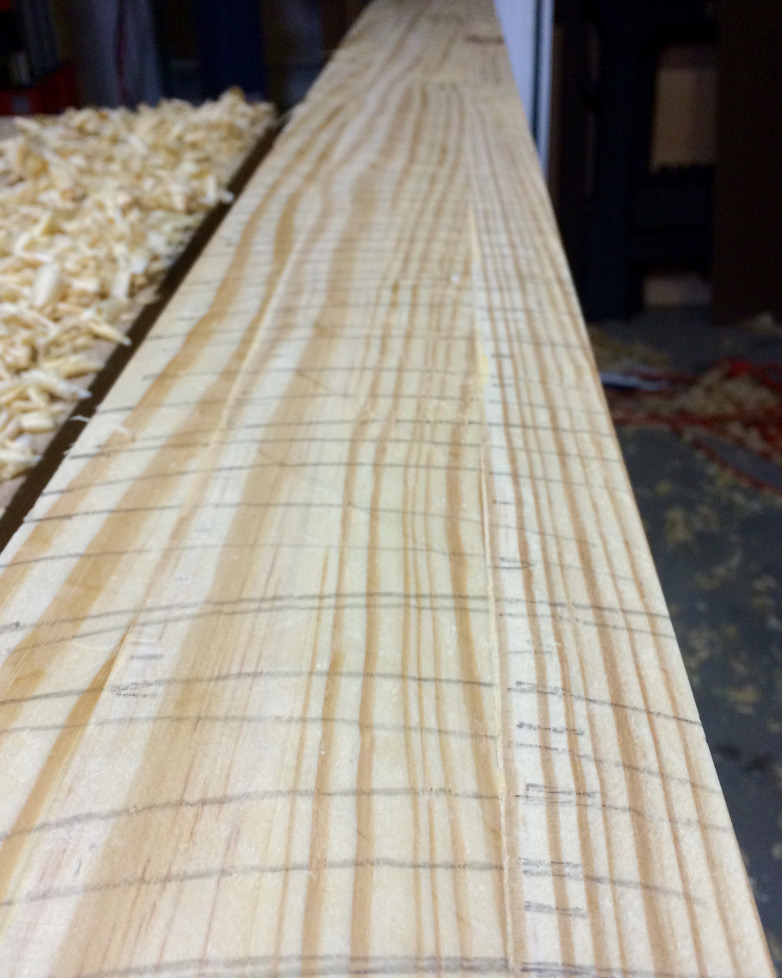
Trusty Jack

My trusty Type 11 Stanley No. 5, made quick work of milling these beams by hand.

Milling large beams by hand, can be very intimidating. I had a few boards slip during glue-up and was afraid it would take forever to correct. Fortunately, a sharp jack plane with a cambered iron made quick work of the rough milling for the Roubo bench top.

Glueup Slippage

These boards slipped during glue-up

I started by planing with the grain until I leveled out any misaligned boards.  I would usually start planing across the grain, but in this case I could remove the same amount of material in one long pass with the grain as I could several short strokes across the grain.  In the picture above, you can how some of the boards slipped during glue up.  I should have taken more effort to keep the boards properly aligned during the glue up.

Marking out the beams

Marking out your work, allows you to track your progress

Once I had leveled out the high boards, I marked out the entire beam with pencil.  This will allow me to track my progress.  Be sure to mark from edge to edge.  Now it was time to get to work.  I hope you ate your Wheaties!

Planing Cross Grain

Planing cross grain will flatten the board. It’s particularly good at remove cupping.

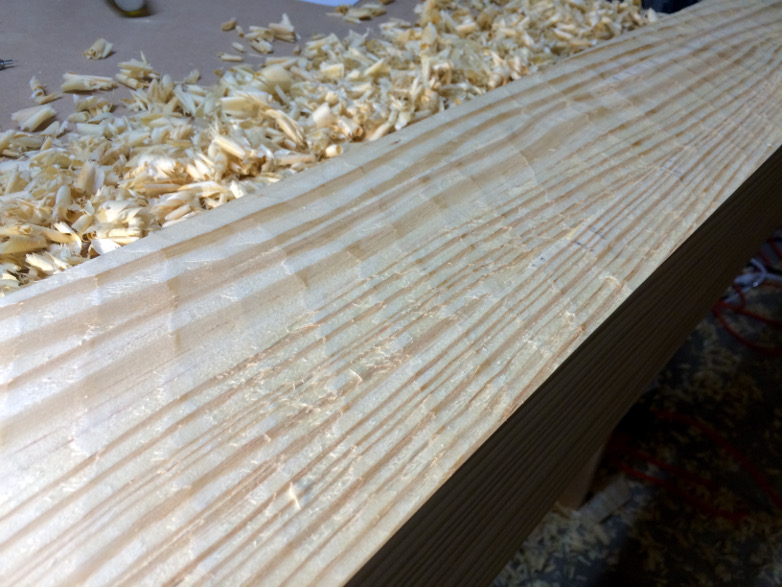
Next, I start flattening the beam by planing across the grain.  This is particularly good at removing cupping.  These beams are just over 5 inches wide, so it would be easy to round over the edges planing 90 degrees to the grain.  Instead, I planed down the length at 45 degrees one way, and back down the other way.  My iron is heavily cambered and leaves a visibly scalloped surface.  That’s okay.  All I am shooting for is a face that’s flat and straight enough to run through the planer.  It does not need to be super smooth.  I continue until all of my pencil marks have been removed.

Ultimately, I just want to make sure that the surface is straight and free of any bumps.  You can check for any bumps along the length of your plank by using a straightedge or the blade of a square.

The winding sticks are showing a fair amount of twist

The winding sticks are showing a fair amount of twist

The next task is to check the beam for twist using a pair of winding sticks.  The winding sticks will exaggerate the twist and tell you where your high spots are.  I like to keep one stick stationary at one end of the board, and run the other down the length, checking in 3 or 4 places.  In this case, I noted that the rear stick read high on the right for the entire length of the board.  Instead of removing material from the entire length, it was easier to remove a small amount of material from the front left, to match the rest of the board.

No twist

No twist

Checking for bow

Checking for bow

Once you have your plank flat and free of twist, you need to ensure that it’s reasonably straight.  I do this, by using the longest straight edge I have.  In this case, it was a 4 foot level I know to by reasonably straight.  Be sure to check in several places.  I was lucky.  This board was nearly dead straight.  However, if you have a bump or concavity, it’s just a matter of marking and removing the high spots.

I didn’t feel the need to break out the No. 7 for this task.  Running the beams through the planer will produce an parallel surface that is straight, free-of-twist, and smooth.  It’s just a matter of flipping the board over and getting the other side smooth.  The No. 7 will come in handy when flattening the bench top after the final glue up.

Please, let me know if you have any questions.  I will cover the rest of the milling process and the final glue up of the top in a future article.  Don’t miss it.

You can find links to my other Roubo posts here:  Project Index
Bench Top Lamination Follow Up

Beams for the Roubo Bench Top

Beams for the Roubo Bench Top

I finished the last section of my bench top lamination and  learned some valuable lessons along the way. Overall, things went well, but there are a few things I would do differently in the future. The biggest challenge was the sheer number of boards for the top and their cumbersome length.

Here are the tips I found most useful:

  • Rehearse your glue up before applying any glue – do this for each section
  • Skip planing is more than fine for this type of glue-up, but beware of hard-to-see snipe
  • Before milling, cleanup your shop. There’s nothing worse than tripping over things will ripping 8 ft long boards in a small shop.
  • A small paint roller speeds up glue application
  • Use glue with a long open time. Titebond Extend will give you plenty of time to get your boards coated and aligned
  • Take your time. I ended up with a couple of sections that have a board slightly misaligned. Even an error of 1/16th will add a lot of work to the final milling
  • Don’t skimp on edge jointing, before ripping your boards to width. This will help ease alignment during your glue-up.
  • Don’t skimp on the glue.
  • While we’re at it, don’t skimp on the clamps.  Use as many as you have.
  • If using a resinous wood, wipe the surfaces down with a fast drying solvent before applying glue.  This will allow the glue to penetrate deeper.
  • Allow the squeeze out to become leathery and scrape as much off as possible before it fully hardens

If anyone else out there has similar experience, what tips did you find useful?

You can find links to my other Roubo posts here:  Project Index
Benchtop Lamination Follow Up

Bench Top Sections Glued Up

Bench Top Sections Glued Up

I finished the last section of my bench top and I learned some valuable lessons along the way. Overall, things went well, but there are a few things I would do differently in the future. The biggest challenge was the sheer number of boards for the top and their cumbersome length.

Here are the tips I found most useful:

  • Rehearse your glue up before applying any glue – do this for each section
  • Skip planing is more than fine for this type of glue-up, but beware of hard-to-see snipe
  • Before milling, cleanup your shop. There’s nothing worse than tripping over things will ripping 8 ft long boards in a small shop.
  • A small paint roller speeds up glue application
  • Use glue with a long open time. Titebond Extend will give you plenty of time to get your boards coated and aligned
  • Take your time. I ended up with a couple of sections that have a board slightly misaligned. Even an error of 1/16th will add a lot of work to the final milling
  • Don’t skimp on edge jointing, before ripping your boards to width. This will help ease alignment during your glue-up.
  • Don’t skimp on the glue.
  • While we’re at it, don’t skimp on the clamps.  Use as many as you have.
  • If using a resinous wood, wipe the surfaces down with a fast drying solvent before applying glue.  This will allow the glue to penetrate deeper.
  • Allow the squeeze out to become leathery and scrape as much off as possible before it fully hardens

If anyone else out there has similar experience, what tips did you find useful?

You can find links to my other Roubo posts here:  Project Index
Jointing Long Edges by Hand

fullsizerender

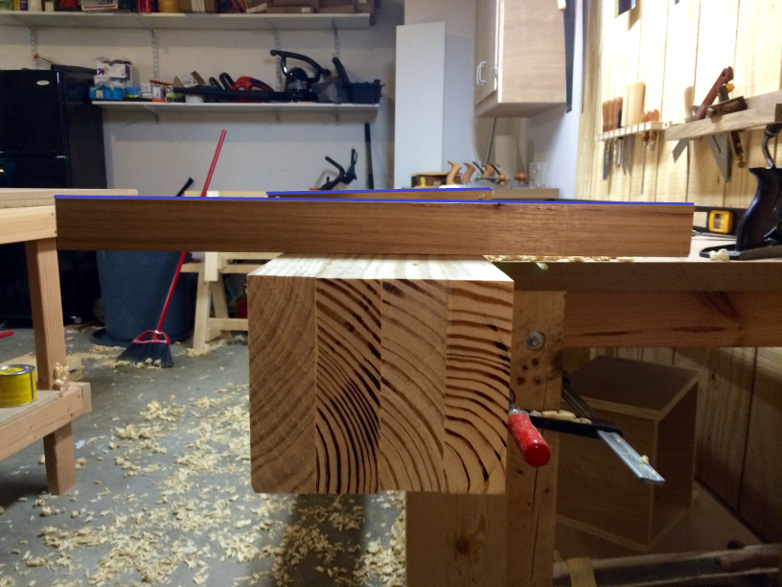
Jointing long edges by hand ended up being a little more work than I expected. Yellow pine planes nicely, but it’s resinous nature creates a lot of friction. It also required spending a little extra time cleaning my tools free of the resin.

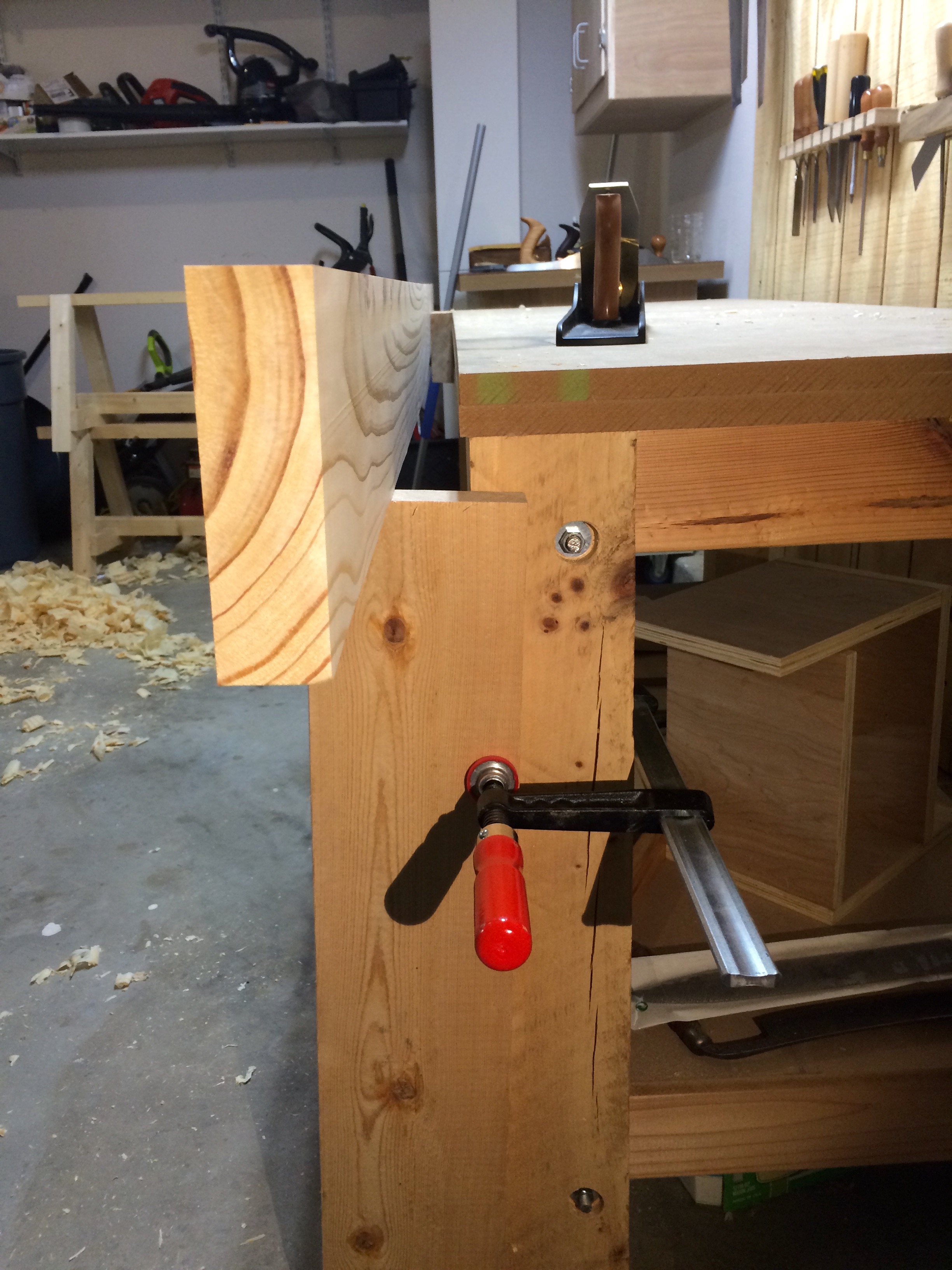
My current workbench couldn’t support the long boards for edge jointing. I worked around this by cutting a scrap board to the approximate height of my vise and clamping that to the opposite leg. This allowed the other end of the board a place to rest.

fullsizerender2

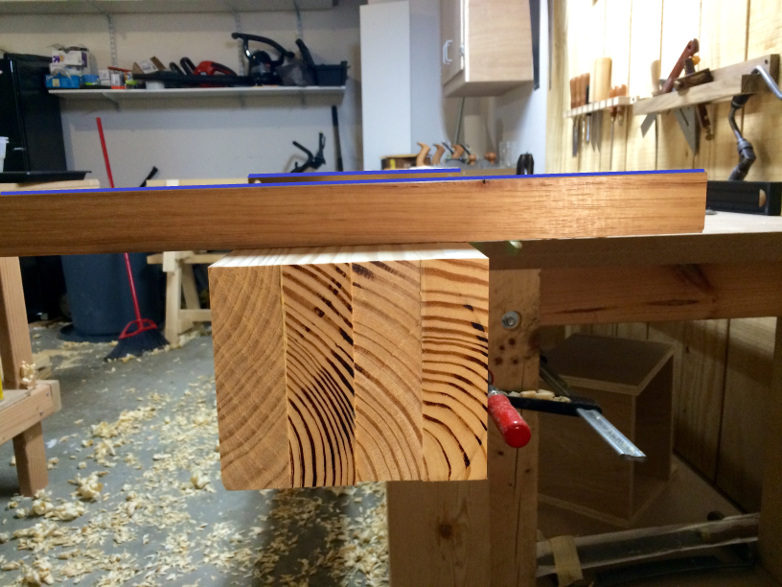
From there it was just a matter of ripping these boards to width on the band saw. These narrow boards gave much less fuss than the original 11″ wide boards. The resulting boards end up being nearly quartersawn. The board shown above was the worst of the bunch.  As a result there’s no need to joint the faces of these boards. I’ll just run both sides through the planer and glue them up.

Stay tuned.

You can find links to my other Roubo posts here:  Project Index
Jointing and Ripping

FullSizeRender

Jointing the long boards for the top ended up being a little more work than I expected. Yellow pine planes nicely, but it’s resinous nature creates a lot of friction. It also required spending a little extra time cleaning my tools free of the resin.

My current workbench couldn’t support the long boards for edge jointing. I worked around this by cutting a scrap board to the approximate height of my vise and clamping that to the opposite leg. This allowed the other end of the board a place to rest.

FullSizeRender2

From there it was just a matter of ripping these boards to width on the band saw. These narrow boards gave much less fuss than the original 11″ wide boards. The resulting boards end up being nearly quartersawn. The board shown above was the worst of the bunch.  As a result there’s no need to joint the faces of these boards. I’ll just run both sides through the planer and glue them up.

Stay tuned.

You can find links to my other Roubo posts here:  Project Index

2015 Roubo Build

I’ve been very unhappy with my workbench for quite some time. The MDF top sags due to the weight of the vise. The top is too thin for holdfasts. And the work holding is generally subpar.

I’ve struggled over designs to the point of exhaustion. I eventually settled on the French Roubo with dovetailed through tenons as seen in infamous Plate 11. After much thought, I decided that building furniture was more important to me than a stunning workbench. I dropped the dovetails in favor of stub tenons. This will allow me to build the bench in significantly less time.

There is no desire for rock hard or exotic lumber here. I settled for cost-effective, Soutern Yellow Pine. I had to sort through an entire stack of 2×12’s at the local Borg, but I was able to find enough suitable boards to supply an 8 ft long, 4″ thick top. This left me enough greenbacks in my budget for a Classic Bench Crafted leg vise.

Stay tuned!

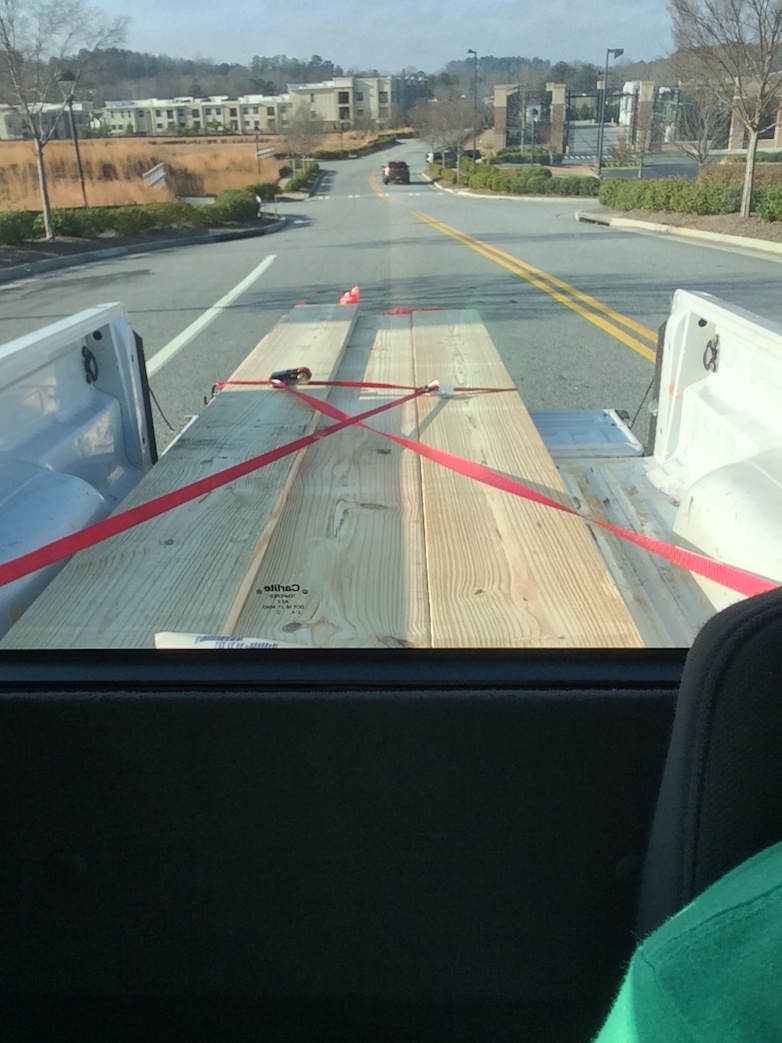
Hauling SYP

Hauling long, heavy boards in my short-bed pickup always makes me nervous

You can find links to my other posts regarding the Roubo build below:

Part 1: The Tension Builds

Part 2: Jointing and Ripping

Part 3: Lamination without Lamentation

Part 4: Sketchup to the Rescue

Part 5: Benchtop Lamination Followup

Part 6: Milling the Beams for the Top

Part 7: Sketchup Design Completion

Part 8: Jointing Wide Edges

Part 9: A Quick Roubo Build Update

Part 10: When Things Come Together

Bonus: Crap Wood for Good Workbenches

Bonus: Jointing Wide Edges by Hand: Companion Video