Blood, Sweat, and Sawdust

Going against the grain

A Serious Garage Door for the Garage Workshop and Other Updates

Garage Door Outside

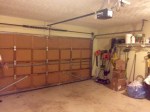
Did I need a new garage door?  No.  However, adding insulation and conditioning won’t do much good if I kept the drafty uninsulated door that came with the house.

This was a long time waiting.  I ordered the door the day after Thanksgiving.  A representative called me the day before the scheduled installation and informed me that the door was backordered.  No worries.  They upgraded me from the R13 door I had purchased to an R18 door, at no extra charge.
Garage Door Inside

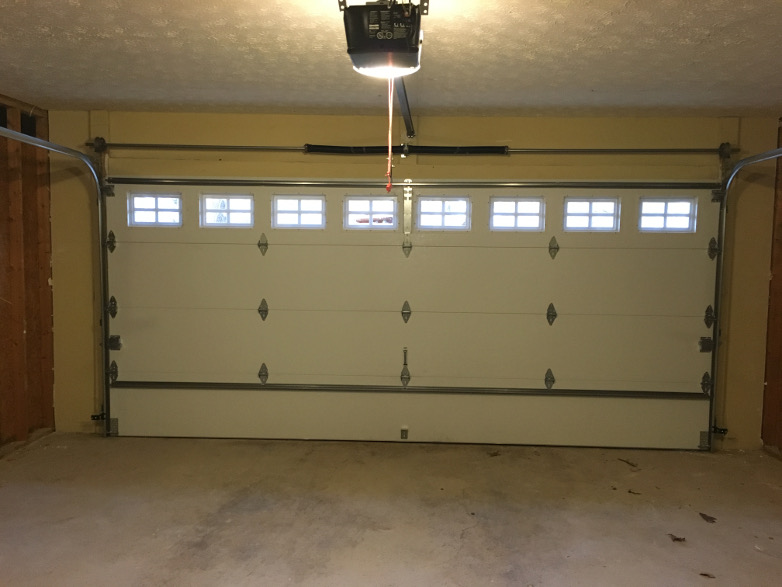
The door sections are two inches thick and filled with polyurethane insulation.  Everything about the door is beefy.  Oh, and the windows are nice too.  I haven’t yet decided if I like the cross inserts yet or not.

Garage Door Assembly

Unfortunately, I couldn’t be there for the installation, but my wife did and excellent job of supervising.  These door sections are very heavy.  I’m not sure how the installer got them into place all by himself.

I am very happy with the new garage door.  It’s of higher quality than I’m used to.  The new seals excel at keeping out the drafts.  The natural light is greatly welcome.  The polyurethane insulation keeps out the noise.  And I’m sure that it will make the mini-split’s job a lot easier down the road.

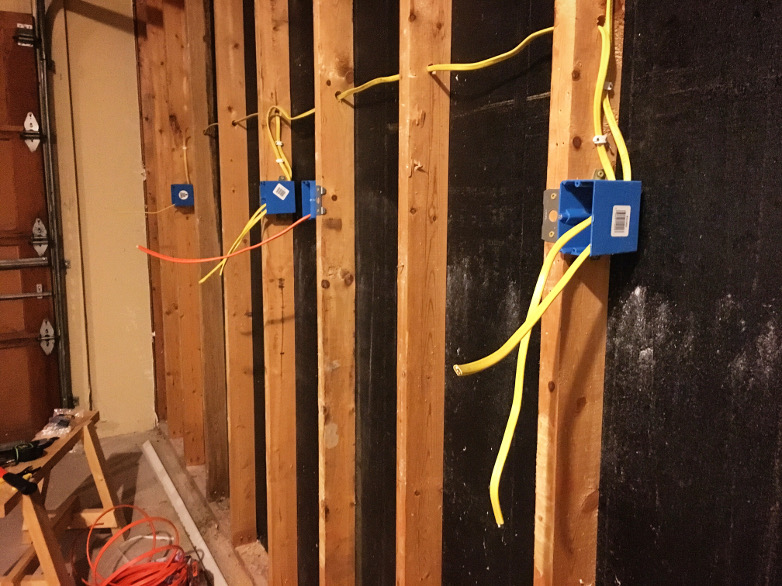
In addition to the garage door, I was able to frame in a side door and get started on my electrical.  More on that later.

Side Door Framing

Electrical Rough Wiring

For the rest of the workshop build, check out the garage workshop build index.


A Few Tips for Workshop Demolition

Workshop demolition isn’t difficult.  Hell, it’s downright fun.  However, have a plan before you get started.

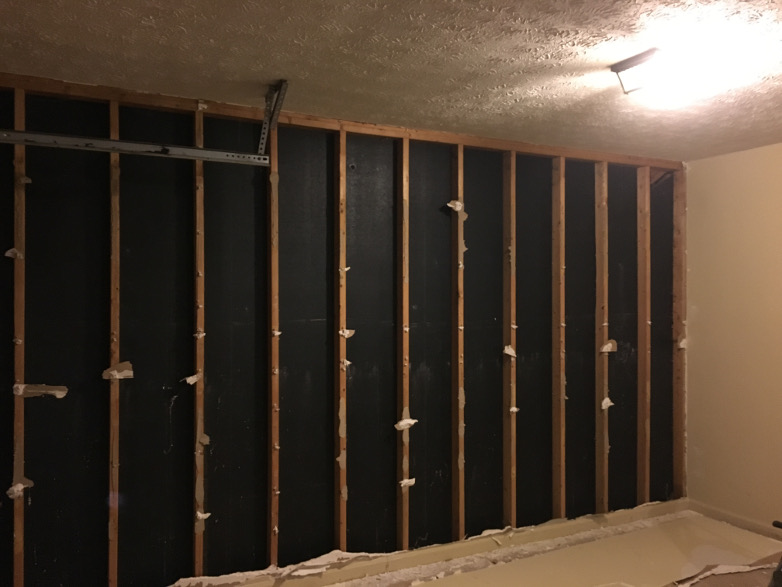
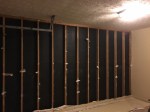
I removed all the drywall on two exterior walls of the workshop to make my life easier.  With the drywall removed, installing electrical, insulation and a new exterior door is much easier.  Here’s a few tips I discovered along the way:

  1. Have a plan for waste disposal.  Dumpster rentals are often expensive.  My cheapest option was to take a truck load to the local dump.
  2. Be ready for the unexpected.  I discovered several sizable holes in the exterior sheathing that needed patched.
  3. Don’t go Wreck it Ralph.  It works for the home-improvement shows, but it will make more work for you….especially if you’re working with drywall.
  4. Use a utility knife and cut the drywall tape in all of your corners.  Not only will this make removal easier, but it will also prevent you from damaging any surfaces you aren’t demoing.
  5. Expect critters, especially in a garage.  Have some bleach and water in a spray bottle, ready for cleanup.

Have a plan and your workshop demolition will be a success.  With demo work complete, I framed in an exterior door and roughed in my electrical.  More on that to come.

For the rest of the workshop build, check out the garage workshop build index.

Planning a Garage Workshop

Planning a garage workshop is intimidating.  Working with limited space is frustrating.  Knowing where to compromise is the key to success.

Create drawings.  Create many of them.  Make one for each of your key systems: structural, machine locations, electrical, dust collection, lighting, etc.

Planning a garage workshop

Drawing 1 – Initial Layout

First, I created a two-dimensional structural drawing.  I drew it to scale and included both existing and future doors, windows, etc.   Then, I added all of my current and future machines.  Any demo work might show more hangups, so don’t hesitate to revise your drawings  if anything comes up.  Keeping things up-to-date will make sure that problems don’t snowball later.

Planning a garage workshop

Drawing 2 – Revised Layout

In my case, removing drywall revealed a sheer wall in a location where I had planned a new exterior door (bottom left of Drawing 1 ).  Moving the door meant relocating a few machines.  This opened up a space close to my workbench at the bottom for hand-tool storage (Drawing 2).

Planning electrical

Drawing 3 – Electrical

With the structural work outlined and machine locations established, I started outlining my electrical needs.  I included power for each of my existing machines as well as machines I plan on purchasing in the future.  If you plan on using an electrician, this drawing will give a clear picture of your expectations.  If you plan on doing the work yourself, it can help you create a shopping list.

workshop light plan

Drawing 4 – Workshop Lighting

Good shop lighting is often overlooked when planning a workshop.  Shoot for around 100 lumens per square foot at the work surface.  I am using 8 x dual-bulb T-8 led fixtures.  This will nearly quadruple the light I had in my old workshop.

Workshop 2-Ducting

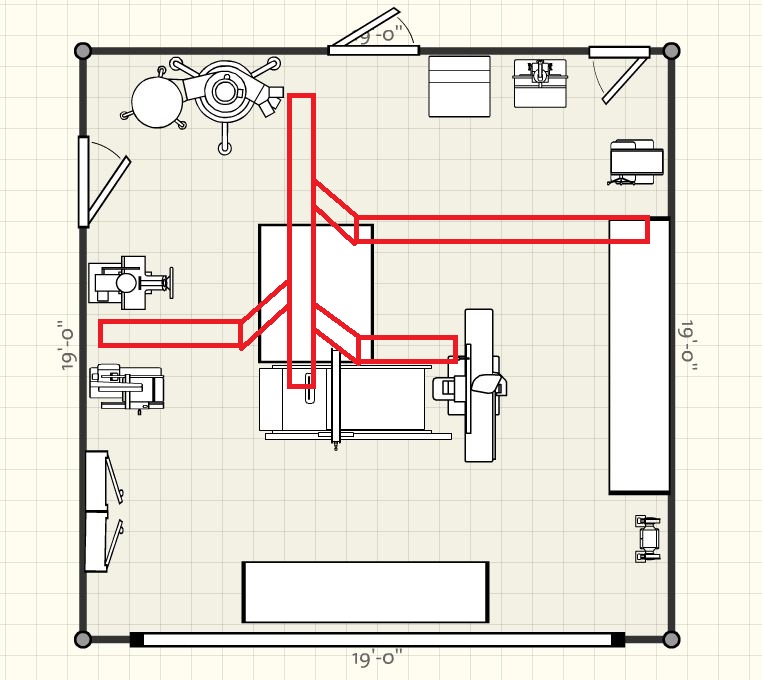
Drawing 5 – Dust Collection

Finally, I plan on adding a stationary cyclone dust collection system in the future.  All of my drawings reflect this.  I created a drawing that included duct work for this future system.  This affected the layout of machines, electrical, and lights.  Creating this drawing illustrated just how important it was to plan out every system and check how each system worked together.  Without it, implementing a ducted dust collection system in the future could have been much more difficult.

I used Grizzly’s workshop planner to create my initial drawings, and then edited them in MS Paint.

For the rest of the workshop build, check out the garage workshop build index.


My Garage Workshop Build

The past few months have been very busy.  In addition to the holidays, we moved into a new house just before Thanksgiving.  This keeps me from building furniture, but also provides a perfect opportunity to build a new shop from scratch.   No longer limited by the rules of a Home Owners Association, I can now install that mini-split air-conditioning unit I’ve always wanted…among other things

In the following weeks, I will detail my progress.  I will detail any helpful tips I discover along the way.  Stay tuned for more of my garage workshop build.


IMG_1889

Part 1: Planning a Garage Workshop

Part 2: Workshop Demolition

Part 3: The Garage Door

Part 4: Workshop Electrical

Part 5: Installing an Exterior Door

Part 6: Insulating a Garage Workshop: Part I

Part 7: Workshop Lighting

Part 8: Hanging Drywall

Part 9: Taping and Mudding Drywall

Part 10: Paint and Trim

Part 11: Ductless Mini-split Air-conditioner

Part 12: Dust Collection: Part 1

Part 13: Dust Collection: Part 2

Part 14: Dust Collection: Part 3

Part 15: Garage Workshop Complete


The Cypress Porch Swing

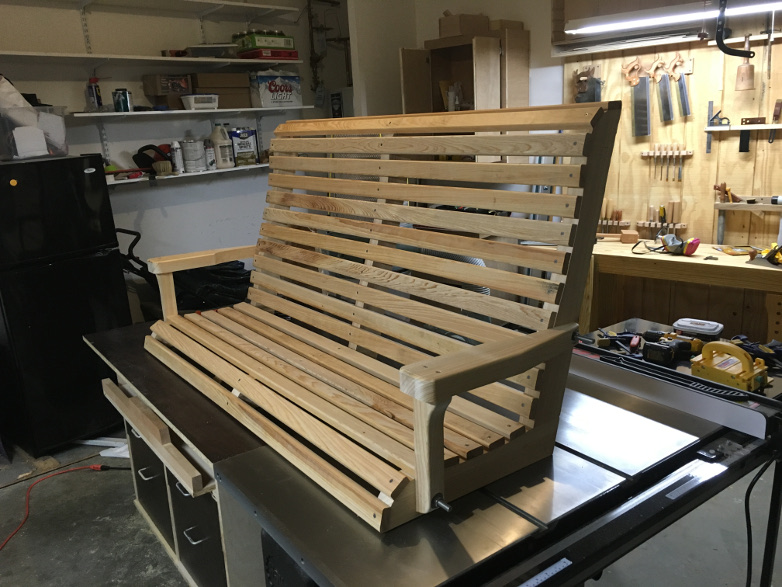
My life is hectic planning for the move.  I’m obsessing over every detail.  I haven’t spent as much time in the shop as I’d like.  However, I did find some time to complete a nice little commission for a friend: a high-back cypress porch swing.

Completed Cypress Porch Swing

I milled the structural components from 8/4 Cypress, and the slats from 4/4 Cypress.  These boards are beautiful.  All of them had tight grain and were completely free of knots.  Most of the boards where 12 inches or wider.  It was a shame to rip them all down.  I used Tite-bond III wood-glue and stainless steel hardware.

Cypress porch swing, half-lap joint

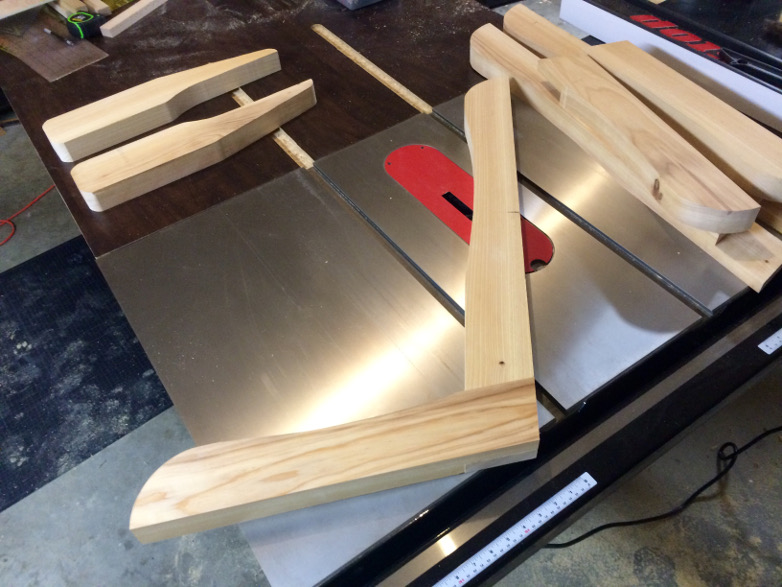
I started by milling up the 8/4 boards.  With the seat and back supports roughed out, I cut the half-lap joints that join the two pieces together.  I did this before cutting the curved profiles.  This made cutting the half-laps on the table saw much easier.  If I ever do this again, I will use bridle joints.

Arms

Support

With the half-laps cut, I cut the curved profiles on the band saw.  I did this before gluing the assemblies together.  Then, I cleaned everything up on the spindle sander.  I also routed a round-over on the top of the arm-rest and the arm-rest bracket.

With the structural components complete, I ripped my 8/4 stock down and routed a round-over on the top of each seat slat.

Sides

Frame

Hardware

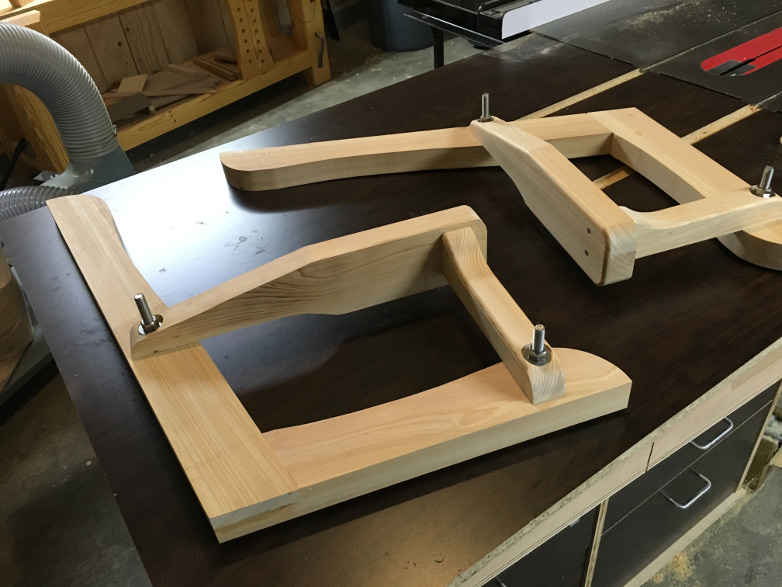
Assembly was very straight forward.  I started with the side assemblies.  I screwed and glued the arm rests to their brackets.  Then I bored the holes and counter-sinks for the carriage bolts that will hold the side assemblies together as well as support the chain.

With the side assemblies complete, I started attaching the seat slats.  I started at the top of the back and front, and worked my way inwards.

Arm

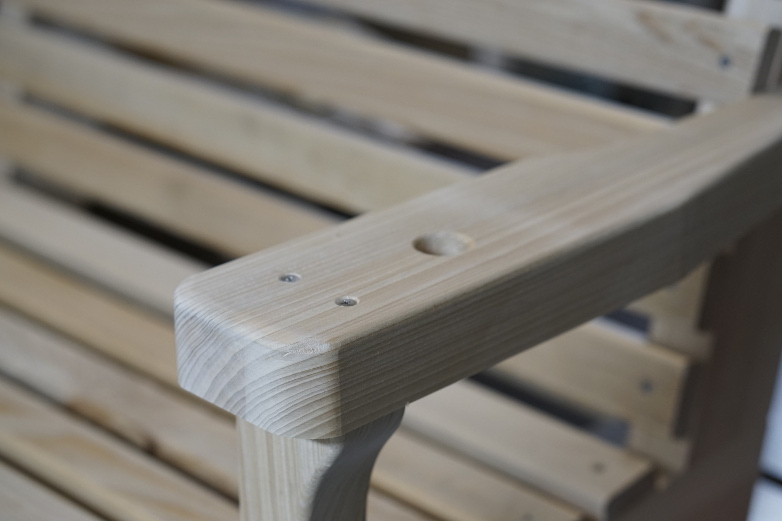
With the swing assembled, I bored a hole to accept the swing chain through the arm-rest.  I finished the swing with a quick sanding.  I think it turned out well, and it should last for some time.


I’m Back

I have a problem with slacking off on the blog towards the end of the summer.  It’s usually the heat.  However, this time I have a better excuse.  I’m getting a new shop.

The goal is to one day build a custom-house with a separate workshop.  That’s not possible at the moment, so we decided to look for something a little cheaper and save money for a few years.  We found the perfect place almost immediately.  So, for the past two months we’ve been getting our current house ready to sell, scheduling inspections, making offers etc.  To say that we’ve been busy is an understatement.  We won’t move into the new place until the end of November, so things will be quiet until then.

The new shop is the same size as the old one.  However, it’s a clean slate.  I won’t have to share it with lawn equipment.  It’s all mine (mua ha ha ha!).

The current plan of action is to:

  1. Rip out drywall
  2. Install Sub-panel and rough-in electrical
  3. Add lighting
  4. Install insulation
  5. Install window
  6. Sheetrock
  7. Install Mini-split
  8. Blow-in insulation to attic area.

There’s a lot of work ahead of me once we finally get moved in, but I’m excited.  I plan to document the process in full.  Let me know if you have any suggestions.

MiniMax FS30 Change Over

Since taking delivery of the Jointer-planer combo, I’ve had a few people ask about the change over between jointing and planing.  The process is quick and easy.  In practice, it takes under a minute.  If I had the Euro guard it would be even quicker.  So far, I’m loving this machine.  It’s very well made and I haven’t made any adjustments to get it working properly.  Let me know if you have any questions about the Minimax FS30 change over.

My First Cabinet Saw

Sawstop

I never thought I’d own a table saw.  I thought they were dangerous.  I thought they were for people who lacked the finesse to master hand tools.  It turns out, there’s so much you can do on a table saw that you can’t do with another tool.

I struggled between the European style sliders and the SawStop.  I decided on the Saw Stop Professional Cabinet Saw with 36″ table.  You can’t beat the European sliding table saws for accuracy and versatility.  However, the Saw Stop is better for me in terms of budget, size, safety, and available support.

That said, the Saw Stop is an excellent cabinet saw.  Assembly is straight forward (the manual is likely the best I’ve ever seen).  The fit and finish are superb.  The mobile base is easy to use.  So far, there’s nothing not to like.  I will give a more in-depth review after I’ve used the saw for a few months.  I’ve only made a few test cuts, but they were square and clean, even with the stock blade (I have a Forrest Woodworker II to try out later).  I also have a dado set on the way.

Stay tuned.  I will have a quick video of the Minimax FS30 in use very soon.

The Beast is Out of the Cage: Minimax FS30 Initial Setup

Minimax FS30

Last night, I powered up the Minimax FS30 Jointer/Planer for the first time.

The Minimax FS30 initial setup is straight forward.  Minimax secures everything to a wooden pallet.  They even nail down the fence and accessories.  The real trick is getting her off the pallet.  This thing is heavy.

I stacked 2 x 8 scraps next to the pallet and carefully walking her off.  Once on the scraps, I employed the help of my lovely wife.  Check out her blog at sewsassycreations.com.  We lowered the Minimax FS30 to the ground by lifting one side and removing a board until she was all the way down.

Removing cosmoline is the most tedious part of the process.  Anyone who has ever received large machinery knows what I’m talking about.  I removed most of the goop with a plastic putty knife.  I removed the rest with lots of rags and a liberal amount of mineral spirits.  With the goop removed, I gave the beds a light coat of Boeshield T-9 and a coat of paste wax.  Don’t forget to get into all the nooks and crannies.  The cutter head and in-feed rollers hide lots of the stuff.

The Minimax FS30 doesn’t come with a power cord, so you will have to make your own.  I used a 10-2 rubber coated cable and 30a twist lock connector.  Everything hooks up to a junction box on the side of the machine.  There are two hot junctions and a ground.  It doesn’t matter which hot wire goes to which hot terminal.  Just make sure you connect your ground wire to the green ground terminal.

From there, it was just a matter of installing the knives and accessories.  These Tersa knives are great.  They install in a matter of seconds.

This thing purrs like an angry kitten.  I’m really impressed with the build quality.  The castings are beefy.  The base is constructed of heavy-duty sheet metal.  The fit and finish are excellent.  I haven’t been able to put her through the paces yet, but the initial cuts impressed me.  The only issues I’ve discovered is that the fence has a very small concavity along its width.  It’s very subtle and I don’t believe it will affect edge jointing in practice.

Stay tuned for a full review.


Embracing Electron Power: My Migration Towards Power Tools

I love my hand tools.  They’re soothing and cathartic.  But, the one thing I love more than using hand tools is designing furniture.  Eventually, I want to do this full-time.  If I want to take this passion full-time, I need to embrace electron power.   I need to focus more time on design and less on milling lumber.  My hand tools will always have a place in my work flow.

Minimax FS30

I start this migration with the purchase of a Minimax FS30 Jointer/Planer combo.  My single most tedious task is milling lumber by hand.  Milling by hand teaches you a lot about wood, but it consumes too much time to focus on design.  I purchased a combo machine, due to limited shop space.  This will be a solid investment.  Minimax has a proven track record and their corporate offices are very close to me.  I also considered Hammer, but ultimately decided to go with the FS30.

The new circuit has been run.  All I need to do is get her off of the pallet.  Free beer for any helpers!

Next, I will buy a table saw.  I love flexible European-style, sliding table saws.  However, most are out of my budget.  Sawstop is my second choice.  They build a solid saw with a proven safety record.  Following that, I will likely invest in a hollow-chisel mortiser.  I plan to build a lot of furniture with mortise and tenon joinery, so this will also come in handy.

It won’t all happen right away, but I will embrace the change and move on to bigger things.  Wish me luck!